

🇬🇷 Why Learn Greek in 2026?
Most people who decide to learn Greek do it for a reason they can name in one sentence. A trip to Santorini that turned into a plan to come back for a month. A grandmother whose stories were half in Greek. A job offer in Athens. A degree in philosophy, theology, or history where the footnotes keep pointing back to a language nobody at the university actually speaks out loud anymore.
Whatever brought you here, 2026 is a genuinely good year to start. Greek has around 13.5 million native speakers — Greece, Cyprus, and a diaspora spread across Australia, the United States, Germany, and the UK — which makes it a mid-sized language with an outsized cultural footprint. It is one of the 24 official languages of the European Union, and it has the longest documented history of any Indo-European language still spoken today: roughly 3,400 years of continuous written record.
That history is the part people underestimate. Learning modern Greek does not just give you a way to order dinner in Nafplio. It hands you a key to a vocabulary you have been using your whole life without noticing. Democracy, telephone, psychology, biology, atmosphere, chaos, drama, athlete, music, idea — these are not loanwords in some abstract academic sense. They are Greek words you already know how to pronounce approximately, and once the alphabet stops looking like a physics equation, you start spotting them everywhere.
Greece itself is also a much more practical destination than it was a decade ago. The digital nomad visa introduced in recent years has pulled in remote workers who intend to stay for a season and end up staying for a year. Tourism is enormous, shipping is enormous, and in both industries a foreigner who actually speaks Greek is rare enough to be memorable. And on a purely human level: Greeks respond to the effort. Say kaliméra properly to a shopkeeper in a village and you will get a conversation, not a polite English reply.
Important
Ready to start learning Greek today? Try Univext free for 14 days — practice speaking with Umi, your AI Greek tutor, for 30 minutes every day.
🔤 The Alphabet Is the First Wall — and It Falls in a Week
Here is the single most important thing to understand about learning Greek fast: the thing that scares people off is also the thing that takes the least time to fix.
The Greek alphabet has 24 letters. Somewhere between 12 and 14 of them you already know, because English borrowed them or because they look and sound almost identical to their Latin counterparts. Alpha is A. Tau is T. Kappa is K. Mu is M. Omicron is O. If you have ever seen a fraternity house, a physics formula, or a math textbook, you have already met half the alphabet.
The letters that actually need learning fall into three small groups:
The false friends. These are the traps. Ρ (rho) looks like an English P but sounds like R. Η (eta) looks like an H but sounds like the "ee" in feet. Χ (chi) looks like an X but sounds like the ch in Scottish loch. Ν (nu) looks like an N and is one — but its lowercase form ν looks like a V. These four are responsible for most beginner mispronunciations, and once you have consciously flagged them, they stop being a problem.
The genuinely new shapes. Ξ (xi), Ψ (psi), Θ (theta), Φ (phi), Λ (lambda), Γ (gamma), Δ (delta). Seven letters. That is roughly a week of ten-minute sessions.
The vowels that all sound the same. This is the real work. Greek has six different ways to write the "ee" sound: η, ι, υ, ει, οι, and υι. They are pronounced identically. This is not a pronunciation problem — it is a spelling problem, and it is one you can safely defer for months. You can speak Greek beautifully while spelling it badly.
Example
Try reading these without knowing any Greek: ΤΑΞΙ (taxi), ΜΠΑΡ (bar), ΚΑΦΕ (café), ΣΟΥΠΕΡ ΜΑΡΚΕΤ (supermarket), ΦΑΡΜΑΚΕΙΟ (pharmacy), ΜΟΥΣΕΙΟ (museum), ΞΕΝΟΔΟΧΕΙΟ (hotel). Street signs in Athens are a free reading exercise, and you can pass it on day three.
The practical consequence: do not treat the alphabet as a prerequisite you must complete before starting. Learn it while you are already speaking. Every day you spend drilling letters in isolation is a day you are not building the thing that actually takes months — your ear and your mouth.
For a letter-by-letter walkthrough with audio, see our full guide to the Greek Alphabet: All 24 Letters.
Become bilingual in 30 days with Univext!
Start a lesson with our teacher for free and become bilingual like our 100,000 students!
🤔 Is Greek Hard to Learn? (Honest Answer)
The Foreign Service Institute puts Greek in Category III — around 1,100 hours of study for professional working proficiency for a native English speaker. That is harder than Spanish or French, easier than Arabic, Japanese, or Korean. It is in roughly the same bracket as Russian, Polish, and Hindi.
Where the difficulty actually lives, ranked honestly:
Hard: the case system. Greek nouns change their endings depending on their role in the sentence. There are four cases — nominative, genitive, accusative, and vocative — and every noun and adjective has to agree in gender, number, and case. Compared to Polish (seven cases) or Russian (six), four is merciful. But it is still four more than English has, and it is the thing that takes the longest to become automatic.
Hard: three genders and the article that goes with them. Every Greek noun is masculine (ο), feminine (η), or neuter (το), and the article changes with the case. There are patterns — most nouns ending in -ος are masculine, most in -α or -η are feminine, most in -ι or -ο are neuter — and the patterns hold often enough to be worth learning. We cover this in detail in Greek Has Three Genders: ο, η, το for Beginners.
Medium: the accent. Every Greek word of more than one syllable carries a written accent mark showing which syllable to stress, and the stress genuinely changes meaning. Πότε (póte) is "when"; ποτέ (poté) is "never". Νόμος is "law"; νομός is "county". The good news is that Greek tells you — unlike English, the stress is written down. You just have to actually read it and respect it, which beginners routinely do not.
Easy: pronunciation. Modern Greek is close to phonetic. Once you know the letters and the digraphs, you can read a word you have never seen and pronounce it correctly. There are no silent letters, no unpredictable vowel shifts, no English-style spelling chaos. The sound inventory is also friendly to English speakers — there is no Polish szcz, no French nasal vowels, no Mandarin tones.
Easy: vocabulary you already own. This is Greek's genuine cheat code. An educated English speaker passively knows several thousand Greek roots. You do not have to build vocabulary from zero — you have to activate vocabulary you already have.
Notes
Greek is a language where the first two weeks feel disproportionately hard and month four feels disproportionately easy. Most people who quit, quit in week two — at the alphabet — which is exactly the wall that collapses fastest if you push through it.





Join more than 100,000 students learning on Univext
⏱️ How Long Does It Take to Learn Greek?
Timelines depend on daily commitment and, more than anything, on whether you are actually speaking or just studying. Here is a realistic breakdown assuming 30 focused minutes a day with an AI tutor:
Notice the first row. Alphabet fluency in under a week is not a marketing claim — it is the actual observed timeline for an adult doing ten minutes a day. That is why the alphabet should never be the reason you delay starting.
For a deeper look at the numbers, read How Long Does It Take to Learn Greek?.
🚀 7 Proven Steps to Learn Greek Fast
Step 1: Learn the Alphabet in Parallel, Not First
Spend ten minutes a day on letters and spend the other twenty speaking. If you sequence them — alphabet first, speaking later — you will spend three weeks on something that deserves one, and you will arrive at speaking practice already tired of the language. Start saying Γεια σου (yá sou — hi) out loud on day one, before you can spell it.
Step 2: Speak From Day One, Badly
Greek beginners have a specific failure mode: they wait until they understand the case system before opening their mouths. That is a two-year wait. Greeks will not correct your accusative endings in a taverna — they will be delighted you tried. On Univext you talk with Umi in your first lesson, which means your mouth starts building muscle memory for Greek sounds immediately instead of a year from now.
Step 3: Mine the Vocabulary You Already Have
Before learning a single new word, harvest the ones you own. Φιλοσοφία, δημοκρατία, μουσική, πρόβλημα, ιδέα, θέατρο, ιστορία, γεωγραφία, τηλέφωνο, αυτόματο. Read them in Greek script and you have both an alphabet drill and a vocabulary win in the same exercise. Then move to the true survival set: Γεια σας (hello, formal), Καλημέρα (good morning), Ευχαριστώ (thank you), Παρακαλώ (please / you are welcome), Ναι (yes), Όχι (no — and note that it sounds nothing like "OK", which trips up everyone), Συγγνώμη (excuse me), Πόσο κάνει; (how much is it?).
Build systematically with our Greek flashcards.
Step 4: Learn the Article, Not the Noun
This is the single highest-leverage habit in Greek. Never learn a noun by itself — learn it with its article. Not σπίτι but το σπίτι. Not δρόμος but ο δρόμος. Not πόλη but η πόλη. Gender is not information you can reconstruct later, and re-learning a thousand nouns with their genders after the fact is genuinely miserable. Attach the article from the first exposure and the case system becomes a system rather than a fog.
Step 5: Respect the Accent Mark From the Start
Read every accent. Say it out loud with the stress where the mark is. Beginners treat the accent as decoration and then wonder why Greeks do not understand words they pronounced "correctly". Stress in Greek does the work that vowel quality does in English — get it wrong and the word simply does not land. Umi gives instant pronunciation feedback on exactly this, which is the kind of correction a textbook physically cannot give you.
Step 6: Immerse Without Moving to Athens
Switch your phone to Greek — you already know what every menu item does, so you will absorb the vocabulary through pure context. Watch Greek series (Το Νησί, Έτερος Εγώ) with Greek subtitles once you hit A2. Listen to Greek radio while cooking; even passive exposure trains your ear to the rhythm and to where words break. Read the headlines on Kathimerini or Protothema — headlines are short, present-tense, and repetitive, which makes them the easiest real Greek in existence.
Step 7: Practice Daily With an AI Tutor
Human Greek tutors cost $25-50 an hour and have to be scheduled. That is the reason most learners get one hour of speaking a week instead of the daily practice the language actually needs. An AI tutor removes both constraints: Umi is available at 6 AM or midnight, never gets bored of correcting the same ending for the fifth time, and does not make you self-conscious. Thirty minutes a day of real conversation beats three hours a week of flashcards, and it is not close.
Become bilingual in 30 days with Univext!
Start a lesson with our teacher for free and become bilingual like our 100,000 students!
📱 Best Apps to Learn Greek in 2026
Greek exposes a weakness in most language apps: it is a smaller course, so the big platforms invest less in it. Duolingo's Greek tree is shorter and shallower than its Spanish one. Rosetta Stone's Greek content is dated. Here is how the options compare on what actually matters for a case-heavy, alphabet-first language.
Note the second row — Babbel does not offer Greek at all, which surprises a lot of people who assume it covers everything. For the full tested comparison, see Best Apps to Learn Greek in 2026 (Tested & Ranked), and for the head-to-head, Duolingo vs Babbel for Greek.
🎯 Why Univext Is the Best Way to Learn Greek
Meet Umi — Your AI Greek Teacher
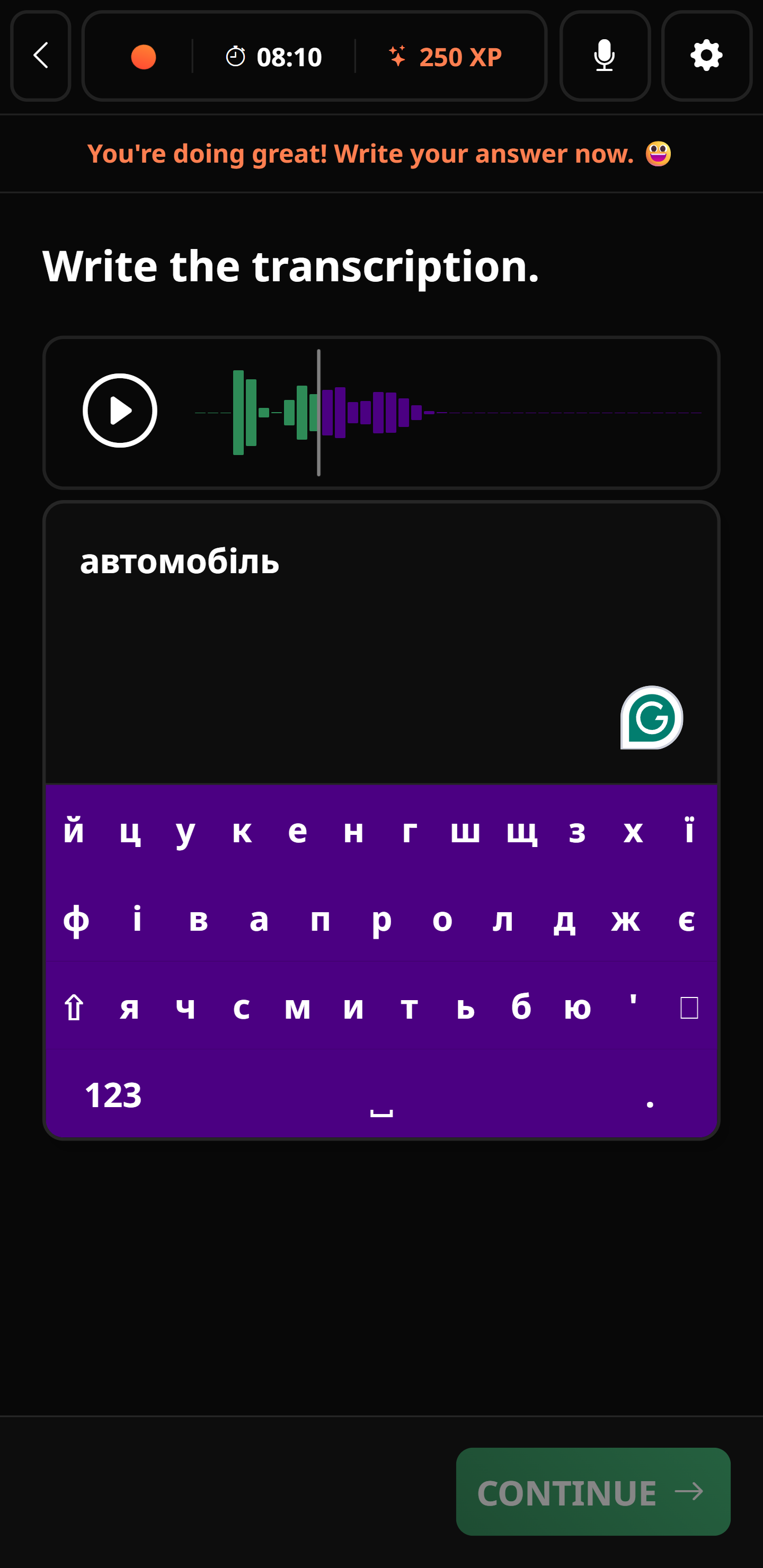
Umi is a voice-first AI tutor, not a chatbot with a speaker icon. You talk, Umi listens, responds in Greek at your level, and corrects you when it matters — which for Greek means three very specific things.
Stress placement. Umi hears whether you put the accent where the written mark says, and tells you when you did not. This is the correction Greek learners need most and get least.
Case endings in context. Rather than making you memorize declension tables, Umi lets you make the mistake in live conversation and then reformulates the sentence correctly. You learn the pattern by hearing the right version immediately after producing the wrong one, which is how children learn and how adults mostly do not get to.
Formal versus informal. Greek distinguishes εσύ from εσείς, and getting it wrong ranges from slightly rude to slightly ridiculous depending on who you are talking to. Umi teaches you which register a situation calls for — a shopkeeper, a colleague, someone's grandmother — the way a person who lives there would.
Umi also handles the alphabet alongside the conversation, so those ten daily minutes of letter work happen inside the lesson rather than as separate homework you will skip.
Important
Stop putting off the alphabet. Claim your 14-day free trial of Univext and spend 30 minutes a day speaking Greek with Umi — you will be reading street signs before your first week is out.
Join more than 100,000 students learning on Univext
📊 Univext vs Other Ways to Learn Greek
Greek has a particular problem here: outside of a few cities with large Greek diasporas, there simply are not many in-person Greek classes. For most learners the realistic choice is between an app and nothing. That makes the quality of the app matter more for Greek than it does for Spanish.
Become bilingual in 30 days with Univext!
Start a lesson with our teacher for free and become bilingual like our 100,000 students!
🏁 How to Get Started Today
- Create your free Univext account — it takes under a minute.
- Select Greek as your target language.
- Take the short placement chat so Umi knows where you are (absolute zero is a perfectly normal answer).
- Start your 14-day free trial.
- Have your first spoken Greek lesson today and say Γεια σου, με λένε... out loud.
If you are weighing whether the language is worth the effort at all, read Is Greek Hard to Learn? The Honest Answer first. And if a trip is what started this, take Basic Greek Phrases for Travel with you.
⚠️ 6 Mistakes That Slow Greek Beginners Down
- Treating the alphabet as a gate. It is a week of work, not a semester. Learn it in parallel with speaking, not before it.
- Learning nouns without their article. The most expensive shortcut in Greek. Gender is not recoverable later without re-learning the entire vocabulary.
- Ignoring accent marks. They are not decoration, they are pronunciation instructions, and skipping them makes you unintelligible in ways you will not be able to diagnose yourself.
- Reading Greek in transliteration. Kalimera is a crutch that becomes a cage. Every week you spend reading Greek in Latin letters is a week your brain is not building the actual reading pathway.
- Studying ancient Greek grammar to learn modern Greek. They are related the way Latin and Italian are related. If you want to speak in Athens today, learn modern Greek and let the ancient roots be a bonus.
- Waiting to be "ready" to speak. There is no ready. There is only earlier or later, and earlier is better.
Our detailed breakdown of the specific traps is in Greek Letters Lie: 15 Traps in Your First Year.
🗺️ Your 12-Month Greek Roadmap
- Week 1: Alphabet. All 24 letters, the main digraphs, and the six ways to spell "ee". Say Γεια σου and Ευχαριστώ out loud every day.
- Month 1-2 (A1): Present tense, the three articles, the nominative and accusative. Learn every noun with its article from the beginning. Daily short conversations with Umi about yourself, your day, your food.
- Month 3-5 (A2): Past and future tenses. Genitive case. Numbers, time, directions, prices. You should be able to travel through Greece using Greek and only occasionally reaching for English.
- Month 6-10 (B1): The subjunctive with να, conditionals, and the beginning of real fluency. Greek subtitles on Greek shows. Opinions, arguments, stories about the past. This is the phase where the case system stops being conscious effort.
- Month 11-12 (B2): Idiom, register, nuance. Reading Kathimerini without a dictionary tab open. Talking politics, work, and history with actual Greeks and holding your own.
Important
The alphabet takes a week. The rest takes as long as you keep showing up. Start your 14-day Univext free trial and let Umi take you through the first week today.
Become bilingual in 30 days with Univext!
Start a lesson with our teacher for free and become bilingual like our 100,000 students!
🌍 Learn Other Languages Too
The same conversation-first method works across every course on Univext. If Greek turns out to be the first of several: