

Italian is the language of opera, Renaissance art, espresso bars, and seventy million native speakers spread across Italy, Switzerland, and a vast global diaspora. It is also one of the most welcoming languages an English speaker can pick up. The U.S. Foreign Service Institute classifies Italian as a "Category I" language — meaning a motivated learner can reach professional working proficiency in roughly 600 hours of focused study, on par with Spanish and French. Italian is famously phonetic: what you read is, almost without exception, exactly what you say. Vowels are clean, consonants are predictable, and stress patterns follow consistent rules. The hard part isn't decoding the script. It's getting comfortable enough to actually open your mouth — to handle the rapid-fire conversation in a Roman café, to sing along with a Tuscan grandmother, to negotiate with a Milanese designer without freezing on the third syllable. That's where most learners stall, and that's where the choice of app makes the biggest difference. A good Italian app gets you reading and understanding within weeks. A great one gets you speaking — confidently, with rhythm, and with the right gendered article in front of every noun.
Here's what we found.
🇮🇹 Why Italian Apps Need to Push You to Speak Early
Italian is unusually friendly to English speakers because so much of the vocabulary is recognizable on sight: banca (bank), museo (museum), informazione (information), organizzare (to organize). You will hit the "I can read a menu" milestone faster than in almost any other language. The danger of this gentle on-ramp is that learners get lulled into passive comprehension — they understand a lot but freeze the moment they try to construct a sentence themselves.
The real challenges of Italian come a bit later: the gendered article system (il, lo, la, i, gli, le), the heavy use of the subjunctive mood, articulated prepositions (al, del, nel, sul, dal), and the conjugation of -are, -ere, and -ire verbs across six grammatical persons. None of these are exotic — Spanish and French have versions of all of them — but they need to be drilled in speaking, not just in fill-in-the-blank exercises. A great Italian app forces you to produce sentences out loud from day one, even imperfectly. A bad one lets you tap colored tiles for six months and call it progress.
Notes
Stuck in the "I can read but I can't speak" trap? Read our deep dive: Why Duolingo Doesn't Teach You to Speak
📊 The Ranking (TL;DR)
Become bilingual in 30 days with Univext!
Start a lesson with our teacher for free and become bilingual like our 100,000 students!
🥇 1. Univext — Best Overall for Italian
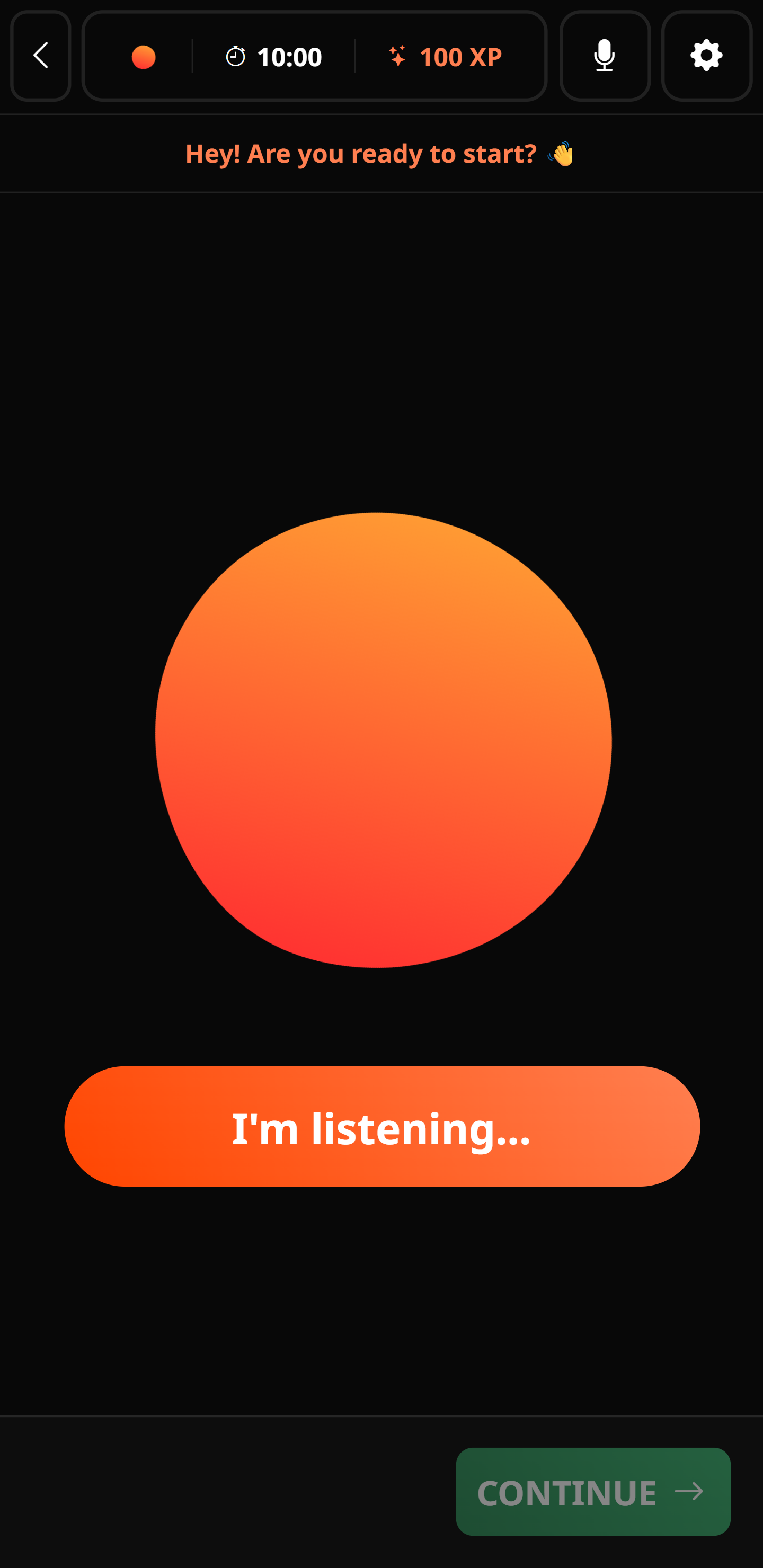
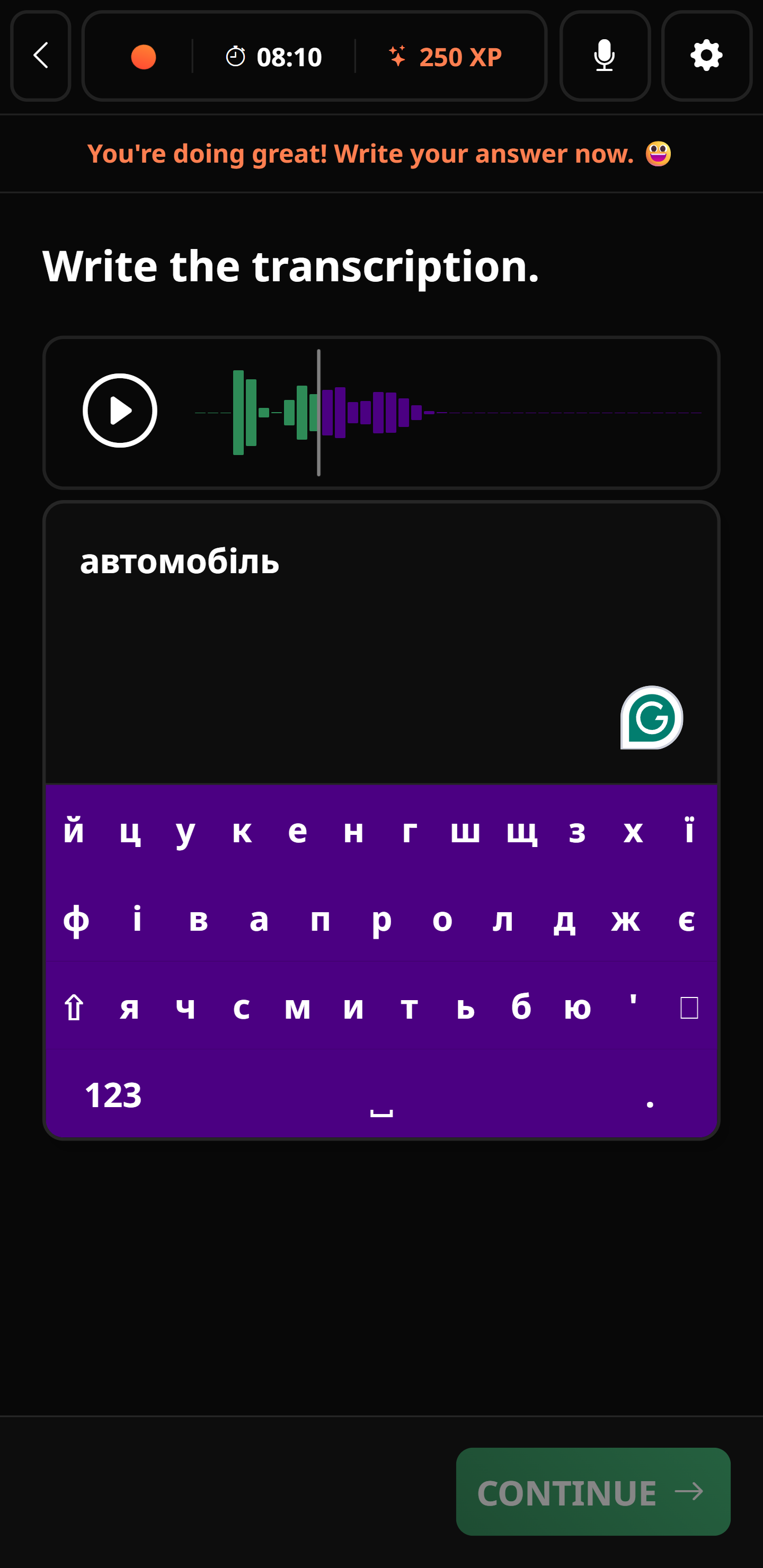
Univext is built around Umi, an AI tutor that talks to you in real Italian, listens to what you say, and corrects you on the spot. Where a flashcard app makes you tap the right answer, Umi makes you say it — out loud, in a real sentence, with the right preposition and the right gender. You start having actual conversations from the very first lesson, not after twenty units of vocabulary drills.
What makes it work:
- Real voice conversations: You speak directly to Umi in Italian and get instant feedback on pronunciation, conjugation, and word order. No scheduling, no awkward Zoom calls.
- Gradual grammar integration: Umi introduces gendered articles, articulated prepositions, and the subjunctive mood through context — not by dumping conjugation tables on you.
- Pronunciation correction in real time: Italian rolled R, double consonants (pizza, spaghetti, gatto), and clean vowels are the difference between sounding fluent and sounding tourist. Umi flags them as you speak.
- Adaptive difficulty: Struggling with the difference between essere and stare? Umi notices the friction and circles back with extra practice until it sticks.
- Daily speaking time, not daily streaks: During your trial you get 30 minutes a day of real speaking practice — enough to build genuine muscle memory.
Important
Try a free Italian lesson with Umi — 14 days free, no commitment. Start your trial →
Where it's weakest:
- No gamification: No streaks, no leaderboards, no cartoon owl. If you need a points system to stay motivated, you might miss it.
- Less polished than legacy apps for absolute zero starters: If you've never seen the Latin alphabet before, Univext assumes you'll pick up the basics quickly — which most adult learners do.
Pricing: Univext offers a 14-day free trial with 30 minutes of conversation time per day. After the trial, you transition to the quarterly Ultra plan, which gives unlimited access to Umi across all twelve of the languages Univext teaches — Italian, French, Spanish, German, Portuguese, English, Polish, Russian, Greek, Japanese, Korean and Ukrainian. One subscription, every language.





Join more than 100,000 students learning on Univext
🥈 2. Pimsleur — Best for Pronunciation and Audio Drills
Pimsleur has been around since the 1960s, and the audio-only method still holds up surprisingly well for Italian. The "graduated interval recall" technique — hearing a phrase, being prompted to repeat it, then revisiting it minutes and days later — is genuinely effective for nailing the cadence of Italian. The vowel-heavy, almost musical rhythm of the language is something you absorb through your ears, not your eyes, and Pimsleur leans into that.
Pros:
- Excellent for developing an authentic Italian accent and sentence rhythm.
- Hands-free — perfect for commuting, the gym, or doing chores.
- Forces you to respond under time pressure, which builds reflexes most apps don't.
Cons:
- Vocabulary feels dated (lots of "Mr. Rossi" and "the embassy").
- Almost no reading or writing — you'll sound great but struggle to read a menu.
- Repetitive over long sessions; daily 30-minute lessons can become a slog.
Verdict: A strong supplementary tool for accent and listening rhythm, but pair it with a script-aware app like Univext to actually become literate.
🥉 3. ItalianPod101 — Best for Listening Variety
If you want hours of native Italian audio organized by level, ItalianPod101 is hard to beat. The library is enormous — beginner dialogues, intermediate cultural deep-dives, advanced news commentary. Native instructors break down regional vocabulary, slang, and the cultural quirks (why Italians don't drink cappuccino after 11 a.m., why "ciao" works for both hello and goodbye) that you won't find in textbooks.
Pros:
- Massive library covering travel, business, food, current events, and pop culture.
- Detailed PDF lesson notes and grammar breakdowns alongside each audio.
- Native instructors with real regional accents (Roman, Milanese, Neapolitan).
Cons:
- Almost entirely passive — you're listening, not producing.
- The dashboard is cluttered and the upsells are constant.
- Very little structured progression; it's easy to wander.
Verdict: A top-tier listening resource and cultural primer, but it won't get you speaking. Pair it with something that makes you talk.
Become bilingual in 30 days with Univext!
Start a lesson with our teacher for free and become bilingual like our 100,000 students!
4. Babbel — Best for Grammar Foundations
Babbel's Italian course feels like a well-organized digital textbook. The lessons are short, the explanations are clear, and the grammar progression is sensible. If you're the kind of learner who needs to understand why a language works the way it does before you feel comfortable speaking, Babbel will scratch that itch.
Pros:
- Clear, concise explanations of Italian grammar — articulated prepositions, the passato prossimo, gender agreement.
- Lessons are bite-sized (10–15 minutes) and easy to fit around a job.
- Useful, real-world vocabulary tied to travel, work, and daily life.
- Priced at roughly $8–15 per month in 2026, depending on how long a commitment you sign up for.
Cons:
- Babbel Speak, the AI speaking mode added in late 2025, is a real improvement — but it is still mobile-only, and its conversations are scripted role-plays, not open dialogue. Outside it, voice recognition remains finicky and rarely catches subtler pronunciation mistakes.
- The course doesn't go especially deep — most learners outgrow it within a few months.
- Feels academic and dry compared to AI-driven conversation tools.
Verdict: A solid entry-level grammar guide. Useful for the first three to six months, less useful after that.
5. Duolingo — Most Popular, Least Effective for Italian
Duolingo is many learners' first stop, and the Italian course is one of its more polished trees. The gamified approach genuinely works for building a daily habit — and for the first few weeks, you'll feel like you're making progress. The trouble starts when you realize the app rarely makes you produce a sentence from scratch in your own voice.
Notes
Already feeling the plateau? Read this first: Why Duolingo Doesn't Teach You to Speak
In 2026 the old "hearts" system has been replaced on mobile by energy — you start each day with a pool of units and every answer spends one, right or wrong. The framing changed; the mechanic did not. It still meters how much a free learner is allowed to practise, and it still optimizes for daily app opens rather than language acquisition. Tapping the right Italian word out of four options six times in a row doesn't prepare you for the moment a barista asks if you want your macchiato in a tazzina or in a glass. For Italian — a language where the real challenge is fluency and rhythm, not memorizing words — Duolingo is the slowest path to actually speaking.
Join more than 100,000 students learning on Univext
🎯 How to Pick the Right App for You
The honest truth: most serious learners end up combining two tools. A speaking-focused app like Univext as the core, plus a listening tool like ItalianPod101 or Pimsleur as a supplement. What you should not do is build your entire Italian study routine on a single tile-tapping app and then wonder why you can't order dinner in Florence.
Become bilingual in 30 days with Univext!
Start a lesson with our teacher for free and become bilingual like our 100,000 students!
🚀 Getting Started with Italian
Italian is one of the few languages where you can realistically aim for conversational survival in 30 days of consistent daily practice. The vocabulary is recognizable, the spelling is logical, and the sound system is closer to English than people expect once they get past the rolled R. The trick is to commit to producing the language from week one, even badly. Order your first coffee in Italian. Reply to a friend in Italian, even if your sentence has three mistakes in it. Learn ten verbs and use them in twenty different sentences before learning ten more.
The two traps to avoid: (1) the "I'll start speaking once I feel ready" trap — you will never feel ready, and waiting is the cause of most six-month plateaus; and (2) the "I'll just keep doing flashcards" trap, which builds passive vocabulary without ever wiring your mouth to your brain.
Important
Ready to actually speak Italian? Start your 14-day free trial of Univext → — 30 minutes per day of real conversation with Umi. No credit card surprises, no streak guilt, no flashcard games. Just Italian.
🌍 Learning Other Languages?
Exploring more than just Italian? Check out our other expertly tested rankings for 2026:
- Best Apps to Learn Spanish in 2026
- Best Apps to Learn French in 2026
- Best Apps to Learn German in 2026
- Best Apps to Learn Portuguese in 2026
- Best Apps to Learn Russian in 2026
- Best Apps to Learn English in 2026
One Univext subscription unlocks every language. The same Umi who teaches you to negotiate gelato flavors in Florence will also teach you to order pelmeni in Moscow or tapas in Madrid.
❓ FAQ
How hard is Italian for English speakers? Italian is one of the easiest languages for English speakers — the U.S. Foreign Service Institute classifies it as Category I, alongside Spanish and French, requiring around 600 hours of study to reach professional proficiency. The phonetic spelling, recognizable vocabulary, and clean vowel system give you a real head start.
How long until I can hold a basic Italian conversation? With a speaking-focused app like Univext and 20–30 minutes of daily practice, most learners can manage survival conversations — ordering food, introducing themselves, asking for directions — within 30 to 45 days. Reaching comfortable, sustained conversation usually takes six to twelve months.
Do I need to learn formal grammar to speak Italian? Not at the start. You can carry a real conversation knowing only the present tense, the passato prossimo (basic past), and a handful of articulated prepositions. Grammar deepens naturally as you speak more — chasing the subjunctive in week one will only paralyze you.
Is there a difference between Italian dialects? Yes — Sicilian, Neapolitan, Venetian, and Sardinian are distinct enough that some linguists treat them as separate languages. But what you'll learn in any standard Italian course is Standard Italian (based loosely on the Tuscan dialect of Florence), which is understood everywhere from Milan to Palermo and is what you'll hear on Italian TV, in newspapers, and in any business setting.
Can I learn Italian for free? You can build a foundation for free using YouTube, Duolingo, and free podcasts — but to reach a level where you can actually hold conversations with native speakers, you'll eventually need a structured tool that makes you speak. The 14-day free trial on Univext is the fastest way to see whether AI-driven speaking practice clicks for you.
Italian rewards anyone who puts in the work. Pick an app that actually makes you speak — and start today.