


🇬🇧 Univext vs Duolingo for English: Which App Actually Teaches You to Speak?
If you're looking to learn English in 2026, Duolingo and Univext are two of the most popular options — but they couldn't be more different in how they teach you.
Duolingo is the most downloaded language app in the world, famous for its green owl, streak system, and gamified lessons. It's free, it's fun, and millions of people use it every day. Univext, on the other hand, puts you in real English conversations from day one with an AI teacher named Umi who listens, speaks, corrects, and adapts to your level.
So which one actually gets you speaking English? This comparison breaks down everything — teaching method, grammar, pronunciation, pricing, and real-world results — so you can make the right choice.
Important
Looking for a broader comparison of English learning apps? Check out our guide to the 5 Best AI Apps to Learn English.
🎯 Teaching Method: Gamification vs Real Conversation
This is the fundamental difference, and it shapes everything else.
Duolingo's Approach: Gamified Drills
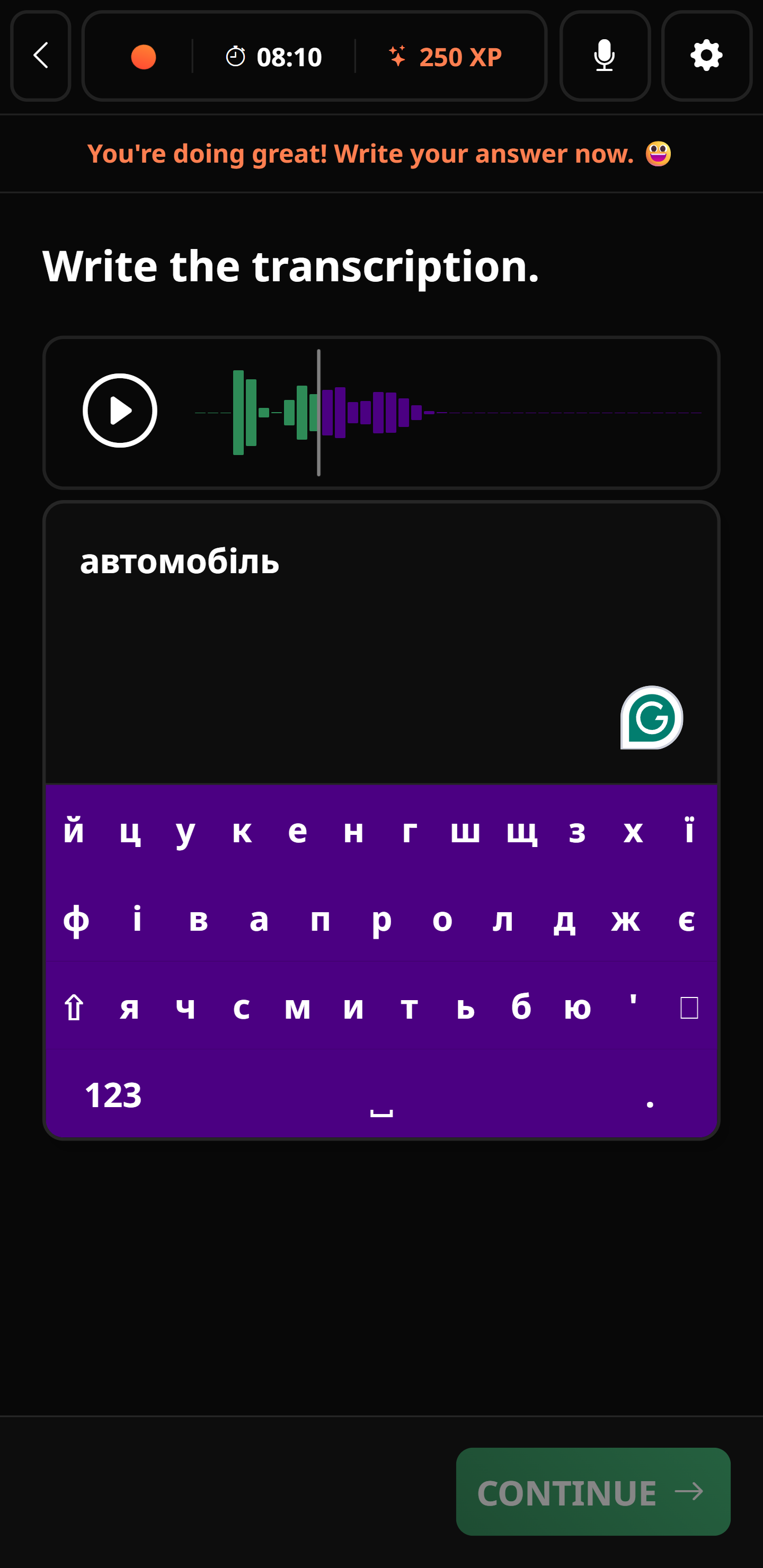
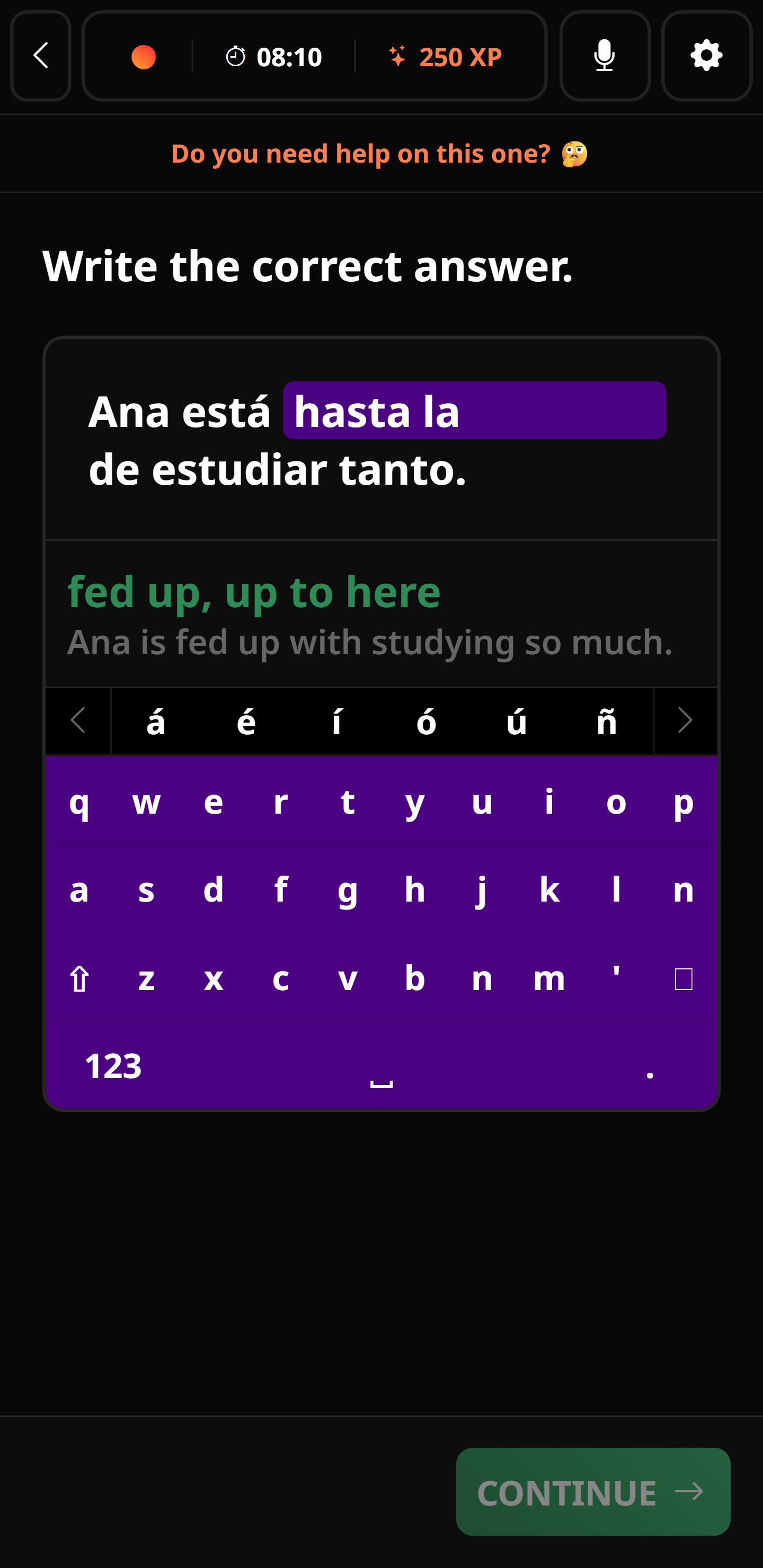
Duolingo teaches English through short, bite-sized lessons built around translation exercises, multiple-choice questions, matching games, and fill-in-the-blank prompts. You earn XP, maintain streaks, compete on leaderboards, and unlock new units as you progress.
The gamification is brilliant for keeping you coming back. The streak system alone has made Duolingo one of the stickiest apps ever built. But there's a catch: the exercises are heavily focused on translating between your native language and English, not on producing English from your own thoughts.
You'll spend most of your time selecting words from a word bank, rearranging pre-written sentences, or choosing between multiple-choice options. These exercises test recognition — not production. And recognition is not the same as speaking.
Univext's Approach: AI Conversation from Day One
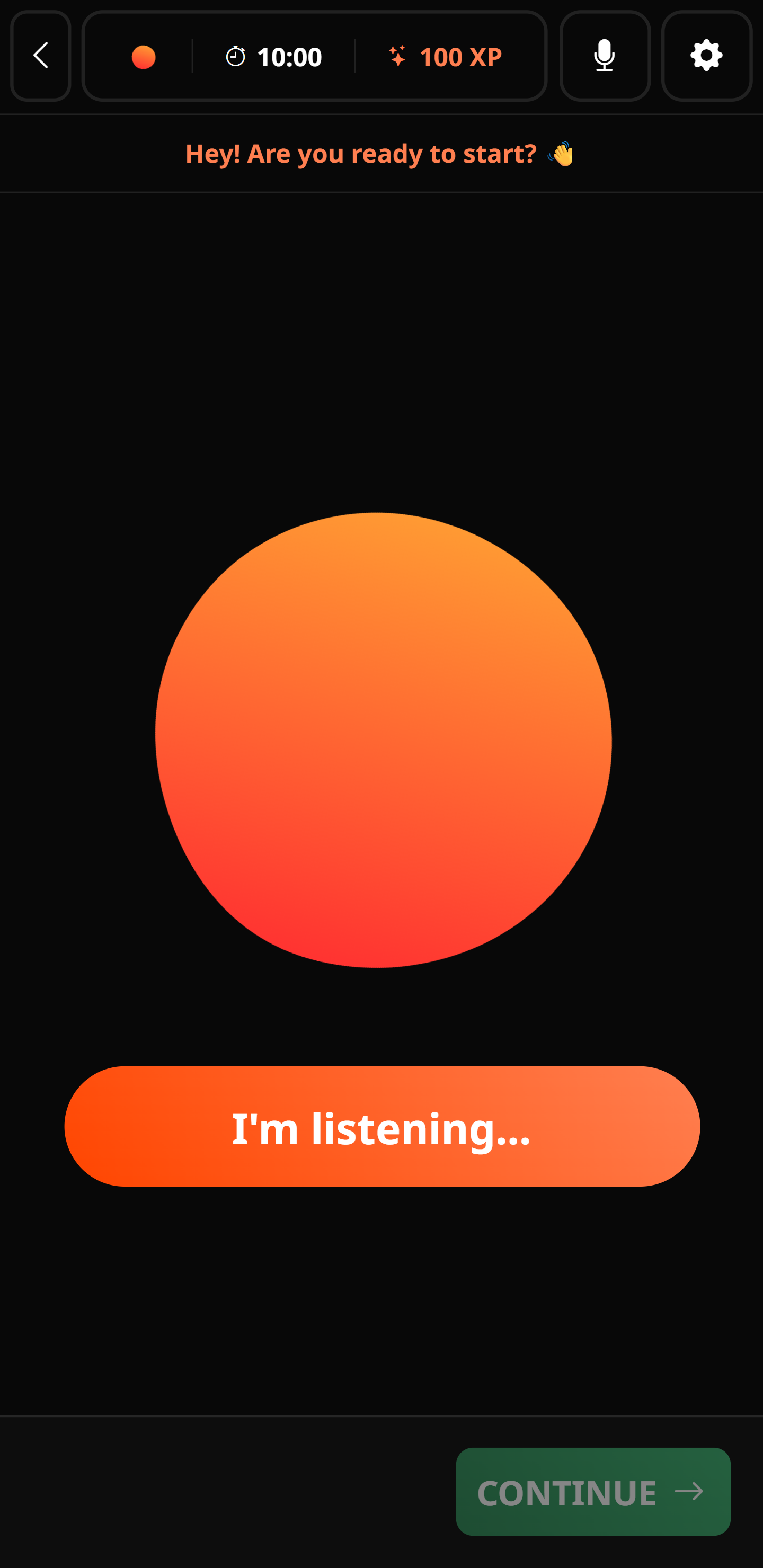
Univext skips the games entirely. From your very first session, Umi speaks to you in English. You listen, you respond in English, and Umi gives you real-time corrections and explanations.
There's no word bank. No multiple choice. No translations to lean on. It's just you and Umi having an actual English conversation — adapted to your level, whether you're a complete beginner or preparing for an advanced exam like TOEFL or IELTS.
This is how children learn their native language. It's how immersion programs work. And it's the fastest path to the goal most learners actually have: being able to speak and understand English in real situations.
Become bilingual in 30 days with Univext!
Start a lesson with our teacher for free and become bilingual like our 100,000 students!
📊 Feature-by-Feature Comparison





Join more than 100,000 students learning on Univext
📗 English Grammar: Tips vs Real-Time Correction
English grammar has its own set of traps that frustrate learners worldwide: irregular verbs (go/went/gone), phrasal verbs (give up, look into, put off), articles (a/an/the vs no article), prepositions that follow no obvious logic, and tense distinctions like the difference between present perfect and past simple.
How Duolingo Handles English Grammar
Duolingo's approach to grammar is mostly implicit. You learn patterns by doing exercises, and some units have optional "tips" that explain rules. But if you make a mistake, you simply get marked wrong and move on. There's no deeper explanation of why you were wrong or how to avoid the same mistake next time.
For example, if you write "I have gone to the store yesterday" instead of "I went to the store yesterday," Duolingo will mark it wrong but won't explain the rule: present perfect ("have gone") can't be used with a specific past time reference ("yesterday"). You're left to figure it out — or more likely, to just memorize the correct answer for that one sentence.
How Univext Handles English Grammar
With Univext, grammar correction is immediate and contextual. When you say "I have seen him yesterday," Umi gently corrects you: "Small correction — 'yesterday' is a specific time in the past, so we use simple past: 'I saw him yesterday.' Use present perfect ('have seen') when the time isn't specified, like 'I have seen that movie before.'"
You can then ask follow-up questions: "When exactly do I use present perfect?" and Umi will walk you through the rules with more examples, right there in conversation. This is how grammar actually sticks — through real errors, real corrections, and real understanding.
🗣️ Pronunciation: Where Duolingo Falls Behind
English pronunciation is notoriously difficult. The same letters can sound completely different depending on the word — think "through," "though," "thought," "tough," and "thorough." English has around 44 distinct sounds but only 26 letters, and spelling gives almost no reliable clues about pronunciation.
Duolingo's Pronunciation Practice
Duolingo has a speaking feature where you repeat phrases and get a pass/fail result. But the speech recognition is binary — you either pass or you don't. It won't tell you that your "th" sounds like "z," that you're stressing the wrong syllable in "comfortable" (it's COM-fter-ble, not com-FOR-ta-ble), or that your vowel in "ship" sounds like "sheep."
For a language where pronunciation differences change meaning entirely (think "beach" vs "b*tch," "sheet" vs a certain expletive), this basic feedback isn't enough.
Univext's Pronunciation Practice
Umi provides continuous pronunciation feedback during conversation. If you mispronounce something, Umi will model the correct pronunciation and explain what to adjust — including word stress, connected speech (how words blend together in natural English), and those tricky minimal pairs that trip up learners.
Because it happens mid-conversation, you immediately practice the correction in context — which is far more effective than repeating an isolated phrase.
Become bilingual in 30 days with Univext!
Start a lesson with our teacher for free and become bilingual like our 100,000 students!
🚀 Speaking Confidence: The Real Test
Here's the question that matters: after six months of daily practice, can you hold an English conversation?
The Duolingo Problem
This has been widely discussed — and even Duolingo's own research acknowledges it. Many dedicated Duolingo users report completing the English course and still struggling to have basic conversations. The app is excellent at teaching you to translate English sentences but much weaker at teaching you to produce English spontaneously.
We wrote a deeper analysis of this issue: Why Duolingo Doesn't Teach You to Actually Speak.
The Univext Difference
With Univext, speaking is not something you unlock after finishing grammar units — it's what you do from minute one. Every session is an English conversation. After six months of daily 30-minute sessions with Umi, learners have had over 90 hours of real English conversation practice.
To put that in perspective: a typical English class meets 3 hours per week, and only a fraction of that is actual speaking practice — especially in classes with 15-30 students. With Univext, you get more one-on-one speaking practice in 3 months than most classroom learners get in a year.
Real-World Scenario: Job Interview in English
- With Duolingo: You can translate "I am looking for a job" from a word bank. But when your interviewer asks "Tell me about a time you handled a difficult situation at work" — you freeze. You've never practiced forming complex, spontaneous answers in English.
- With Univext: Umi has practiced professional scenarios with you. You've discussed your experience, handled unexpected follow-up questions like "How would you approach that differently now?" and learned to use professional vocabulary naturally — not from a word list, but from actual conversation.
💰 Pricing Comparison
Duolingo's free tier is generous, but it comes with ads and a "hearts" system that limits how many mistakes you can make before being locked out (or watching an ad). Duolingo Plus removes these restrictions.
Univext's 14-day free trial with 30 minutes per day gives you enough time to experience real English conversations with Umi and see meaningful progress. That's 3.5 hours of AI tutoring — completely free.
Join more than 100,000 students learning on Univext
💡 Who Should Choose Duolingo?
Duolingo isn't useless — it's a good fit if:
- You want a free, casual way to learn English vocabulary
- You enjoy gamification and need streaks/leaderboards to stay motivated
- You want to study offline during commutes
- You're a complete beginner who wants a gentle introduction before serious practice
- You're not focused on speaking — you mainly want to read English
- You want a supplementary tool alongside a conversation-based app like Univext
Become bilingual in 30 days with Univext!
Start a lesson with our teacher for free and become bilingual like our 100,000 students!
🚀 Who Should Choose Univext?
Univext is the better choice if:
- Your goal is to actually speak English in real conversations
- You want personalized feedback on grammar, pronunciation, and vocabulary
- You learn best by doing rather than drilling exercises
- You want the closest thing to a private English tutor at a fraction of the cost
- You're preparing for TOEFL, IELTS, or Cambridge exams and need speaking practice
- You need English for work, university, immigration, or daily life — not just for a streak counter
Univext also supports other languages if you're learning more than English. Explore our guides for French, Spanish, Italian, Russian, German, and more.
📈 The Verdict: Univext Wins for Speaking English
If your goal is to collect XP and maintain a streak, Duolingo is perfectly designed for that. It's fun, it's free, and it will teach you English vocabulary.
But if your goal is to speak English — to ace a job interview, survive in an English-speaking university, understand native speakers in meetings, or pass the IELTS speaking section — Univext is the clear winner.
The AI conversation approach doesn't just teach you English words. It teaches you to think in English, respond naturally, and handle the unpredictability of real conversation. No amount of multiple-choice exercises can replicate that.
Our Recommendation:
- Start with Univext for your core English practice. The AI conversation method builds real speaking ability faster than any other app.
- Use Duolingo as a supplement if you enjoy the gamification and want extra vocabulary review on the side.
- Check out our related guides: How to Speak English Fluently in 2026, How to Improve My English, or How to Pass TOEFL and IELTS with AI.
❓ Frequently Asked Questions
Is Duolingo good for learning English?
Duolingo is good for building basic English vocabulary and getting daily exposure to the language. However, it lacks real conversation practice, which is essential for fluency. Many learners complete the full English course but still struggle to speak in real situations.
Is Univext better than Duolingo for English?
For speaking and conversational fluency, yes. Univext's AI tutor Umi provides real-time English conversation practice, grammar correction, and pronunciation feedback that Duolingo cannot offer. For free vocabulary review and gamified learning, Duolingo has its place.
Can I use both Univext and Duolingo together?
Absolutely. Many learners use Univext for daily conversation practice with Umi and Duolingo for supplementary vocabulary review. This combination covers both speaking fluency and structured memorization.
How long does it take to learn English with Univext?
Progress depends on your starting level and native language. Most learners report being able to hold basic English conversations within 2-4 weeks of daily practice with Umi. The British Council estimates B1 level requires roughly 350-400 hours of study. With Univext's 30 min/day, consistent practice adds up quickly.
Does Duolingo teach English pronunciation?
Duolingo has basic speech recognition for some exercises, but it only gives pass/fail feedback. It won't explain what you're doing wrong or how to improve specific sounds. Univext provides detailed, real-time pronunciation guidance during natural conversation.
Can Univext help me prepare for TOEFL or IELTS?
Yes. Because Univext focuses on real conversation, it naturally builds the speaking and listening skills tested in TOEFL and IELTS. Umi can also practice exam-style prompts and give feedback on fluency, coherence, and vocabulary — the exact criteria examiners use. Check out our TOEFL & IELTS prep guide for more details.
Become bilingual in 30 days with Univext!
Start a lesson with our teacher for free and become bilingual like our 100,000 students!
✅ Ready to Actually Speak English?
Stop translating sentences from a word bank. Start speaking English from day one with Umi, your personal AI teacher.
Try Univext free for 14 days — 30 minutes a day is all you need to see why AI conversation beats gamified drills for learning English.