


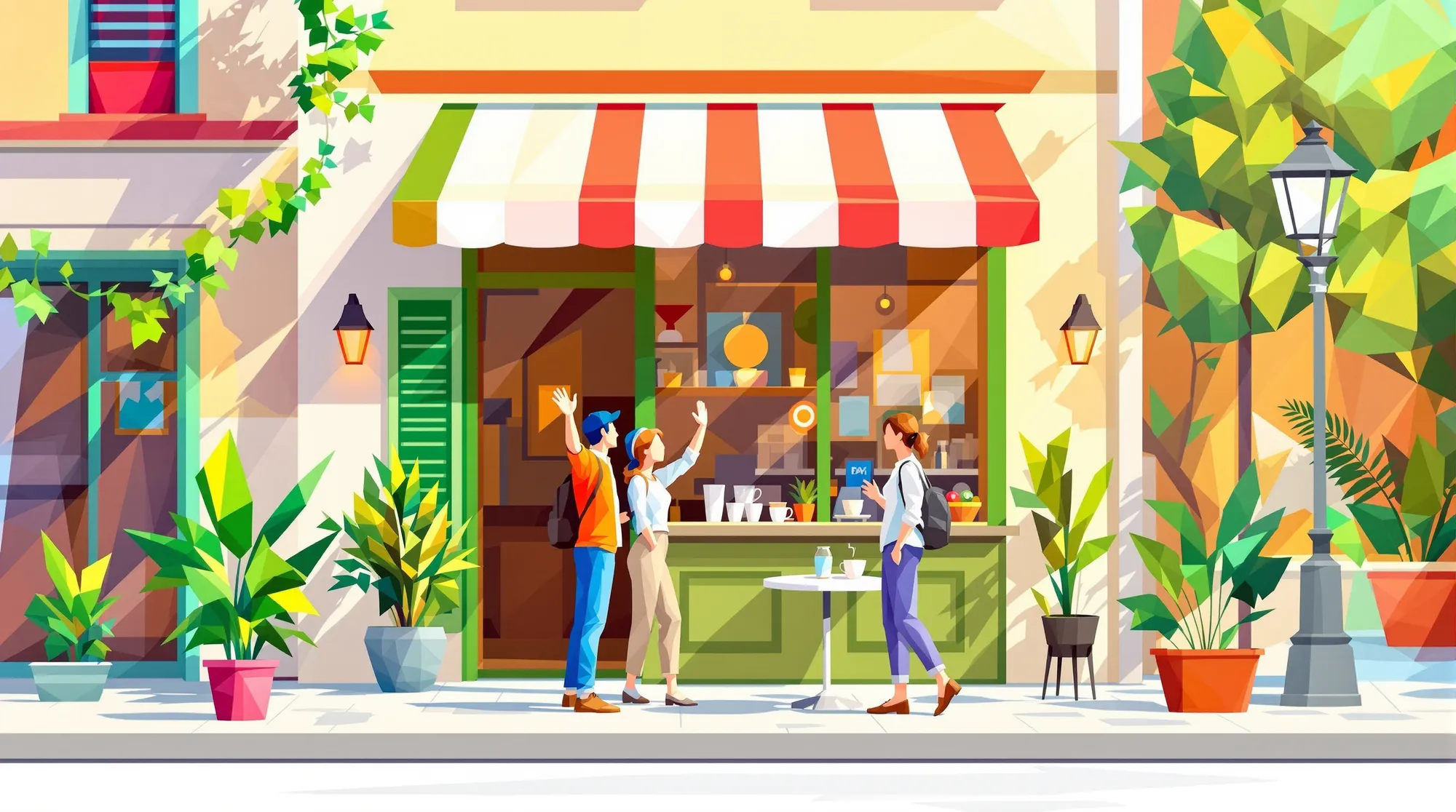
Ten seconds. That is how long you have to not sound like a tourist in Italy. The word you pick for "hello" tells an Italian whether you did your homework or opened a translation app in the doorway.
The good news: there are really only about ten greetings worth knowing, and the rules for choosing between them are simple. The better news is that you can say all of them correctly by the end of this page — tap the audio buttons and copy what you hear. This is not a grammar lesson. It is the shortest path from zero to a greeting that lands.
👋 The 10 Italian Greetings You Actually Need
Each one has an audio button. Tap it, say it out loud, move on. Italian spelling is far more honest than French or English, but the stress falls where you do not expect it, and that is what gives learners away.
1. Ciao — (informal, hello and goodbye) The word everyone knows, and the one most people use wrong. It works in both directions — arriving and leaving — which makes it the most efficient word in the language. But it is strictly informal. Friends, family, people your own age. Never the pharmacist.
2. Buongiorno — (formal, morning until afternoon) The default polite greeting. Shops, offices, strangers, your partner's grandmother. Walking into a bar and saying it before ordering is not optional politeness in Italy — it is simply what is done.
3. Buonasera — (formal, evening) Same job as buongiorno, from roughly late afternoon. Italians switch earlier than you expect — often around 4 or 5pm, not at nightfall. Getting the switch right is a tiny signal that you know what you are doing.
4. Salve — (neutral, the safe middle) The greeting nobody teaches and everybody needs. Neither as stiff as buongiorno nor as familiar as ciao. When you genuinely cannot tell how formal to be, salve is the answer.
5. Pronto — (phone only) Literally "ready". Only when answering a phone. Never as a greeting in person. Ever.
6. Buondì — (light, morning) A cheerful shortened buongiorno, common in the north and in messages. Friendly without being casual.
7. Piacere — (formal, first meeting) Literally "a pleasure". Said while shaking hands the first time you meet someone. Short, universal, impossible to get wrong.
8. Come stai? — (informal, how are you) The follow-up to ciao. It is a greeting, not a real question. The answer is bene, grazie.
9. Come sta? — (formal, how are you) The polite version, for anyone you would address as Lei. One letter apart from the informal, and the difference is heard immediately.
10. Ehilà — (very informal, warm) "Hey there." Close friends only, usually with a smile and surprise attached. Use it wrong and it is not rude, just odd — like calling your boss "buddy".
📊 Which One, When
Important
The single rule that covers 90% of cases: if you would address the person as Lei, say buongiorno. If you would say tu, ciao works. If you have no idea, say salve.
Become bilingual in 30 days with Univext!
Start a lesson with our teacher for free and become bilingual like our 100,000 students!
⚠️ The Two Mistakes Beginners Always Make
Mistake 1: using ciao with strangers. Every phrasebook opens with ciao, so learners deploy it everywhere — at the hotel desk, to the waiter, to an older neighbour. Italians will not correct you, and every one of them will register it. Ciao to someone you have not been introduced to is the equivalent of "yo".
Mistake 2: saying buonanotte when you mean goodbye. Buonanotte is not the evening greeting — it is what you say when the evening is over and someone is going to bed. Use buonasera to greet, buonanotte only to close the day.
Notes
A third, smaller one: the stress in buongiorno falls on GIOR, and the double consonants in words like bello or notte are genuinely held longer. Italians hear the difference between casa and cassa instantly. This is impossible to fix by reading — you have to hear it and copy it.




Join more than 100,000 students learning on Univext
🗣️ The Part a Blog Post Cannot Do
You now know which greeting to use. What you do not have is the thing that actually matters when an Italian is standing in front of you: the reflex. Knowing buongiorno and producing it, at speed, with the right stress, without a two-second pause — those are different skills, and only one of them is learned by reading.
That takes someone to talk to. Umi is our AI tutor: it listens to you speak Italian, hears your accent, and corrects it in the moment — the way a teacher would, except at 11pm on a Tuesday when you finally have twenty minutes.
Important
You are already in the mood to learn Italian. That feeling lasts about an hour. Say ciao to Umi and have a real Italian conversation right now — 14-day free trial, 30 minutes a day, no lesson planning required. Start your free trial
🇮🇹 Where to Go Next
Greetings are sounds before they are words, so the next useful thing is the alphabet — Italian has only 21 letters, and knowing which ones behave strangely fixes half of your pronunciation: Italian Alphabet: Letters and Sounds (2026 Guide).
If you are still shopping around and want to know what learning Italian with an app is actually like in 2026, we tested the main ones here: Best Apps to Learn Italian in 2026.
Otherwise — the ten greetings above are genuinely enough to get through your first week in Italy. Learn the audio, say buongiorno before every question, and keep ciao for people who have already told you their first name.
In bocca al lupo. Or as you can now say properly: .