


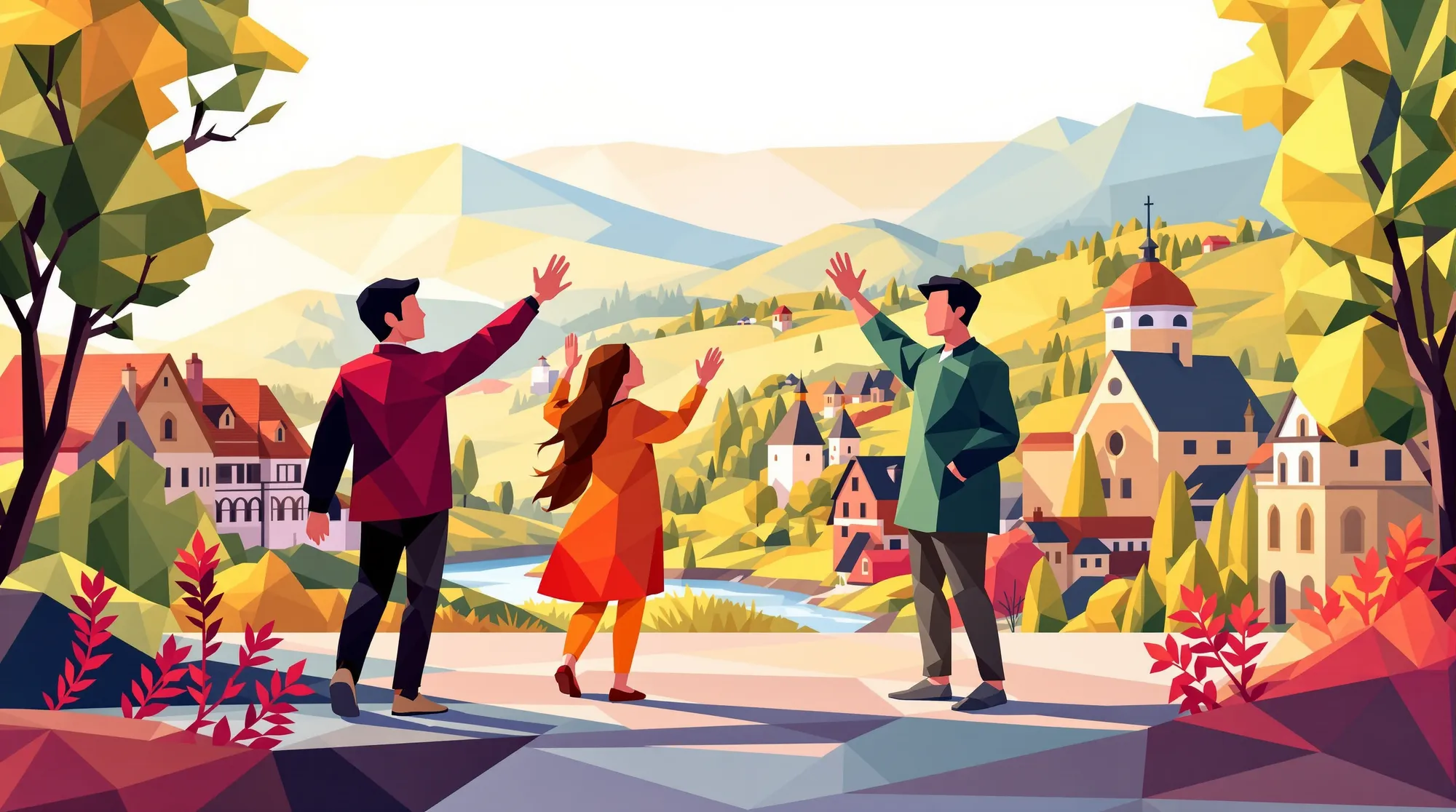
Saying hello is the first thing you will ever do in German — and the first place learners get it wrong. Not because the words are hard, but because Germany has no single "hello". What you say depends on the time of day, on who you are talking to, and, more than in almost any other European language, on where in the German-speaking world you are standing.
Say Guten Tag in a Hamburg bakery and you sound like a news anchor. Say Moin in Munich and people will smile at the foreigner. Say Hallo to your new boss and you have already been slightly too casual.
Here are the 10 greetings that actually get used, with audio, formality, and region marked. Tap any of them to hear a native voice.
👋 The 10 German Greetings You Need
1. Hallo — the safe default
(hah-LOH)
Neutral, works everywhere, works at any hour, works with almost anyone. If you remember one word from this page, remember this one.
2. Guten Tag — the polite one
(GOO-ten TAHK)
Literally "good day". Formal, respectful, used from late morning until early evening. Shops, offices, doctors, strangers.
3. Guten Morgen — before noon
Used until roughly 11am. Germans are stricter about this than English speakers — "good morning" at 2pm gets you a raised eyebrow.
4. Guten Abend — after about 6pm
Evening greeting. Restaurants, hotel receptions, anywhere you arrive after dark.
5. Moin — the north
Hamburg, Bremen, Schleswig-Holstein, Lower Saxony. Despite sounding like Morgen, it is not a morning greeting — northerners use it at 6am and at 11pm. Doubling it, Moin Moin, is friendlier still.
6. Grüß Gott — the south
Bavaria and Baden-Württemberg. Literally "greet God", but nobody hears it as religious any more — it is simply the polite greeting down south, where Guten Tag can sound stiff and imported.
7. Servus — Bavaria and Austria
Warm, informal, and unusually useful: it means both hello and goodbye. Standard among friends in Munich, Salzburg and Vienna.
8. Grüezi — Switzerland
The Swiss-German greeting. Polite, used with strangers and shopkeepers across German-speaking Switzerland.
9. Wie geht's? — hello plus "how are you"
Informal. One warning that catches every English speaker: in German this is a real question, not a noise. Expect an actual answer.
10. Na? — the one-syllable hello
Very casual, very German. Between friends it means "hey, what's up?" — and a returned Na? is a complete conversation.
📊 Which Greeting, Where, When
Become bilingual in 30 days with Univext!
Start a lesson with our teacher for free and become bilingual like our 100,000 students!
🤝 The du/Sie Rule That Decides Everything
German splits "you" in two, and the split reaches back into your greeting.
- Sie — the formal you. Strangers, older people, officials, anyone at work you have not been invited to be casual with. Pair it with Guten Tag, Guten Morgen, Guten Abend, Grüß Gott, Grüezi.
- du — the informal you. Friends, family, children, most people under 30 in a social setting. Pair it with Hallo, Moin, Servus, Na?, Wie geht's?
Important
The safe move as a learner: start with Sie and Guten Tag. Germans will invite you to du when they are ready — and being slightly too formal costs you nothing, while being too casual with the wrong person costs you the room.





Join more than 100,000 students learning on Univext
⚠️ The Two Mistakes Beginners Always Make
1. Treating "Wie geht's?" like "How are you?"
In English it is a greeting that wants no answer. In German it is a question that wants one. Ask it casually and you will get a genuine report on someone's week — which is exactly the moment most learners freeze.
2. Using the wrong register with a stranger
Hallo to a shop assistant is fine. Na? to a shop assistant is not. Register mistakes are the fastest way to sound rude in a language where you did not mean anything at all.
Notes
Bonus mistake: pronouncing Guten Tag with a hard English "g" at the end. The final g in Tag softens toward a "k" — GOO-ten TAHK.
🗣️ Reading It Is Not Saying It
You can memorise all ten in about four minutes. Saying one out loud to a person, at the right moment, in the right region, without a two-second pause first — that is a completely different skill, and no list on the internet builds it.
That gap is where most German learners stall. They can recognise Grüß Gott. They have never once said it.
Important
Say your first German greeting out loud tonight. Umi, our AI tutor, listens, answers back, and corrects your pronunciation in real time — no schedule, no other students in the room, no waiting. Start a free lesson in German →
Become bilingual in 30 days with Univext!
Start a lesson with our teacher for free and become bilingual like our 100,000 students!
📚 Keep Going
- German Alphabet: All 30 Letters and Sounds (2026) — the sounds behind the greetings
- Basic German Phrases for Travel: 50+ Essential Words (2026) — what to say after hello
- Best Apps to Learn German in 2026 (Tested & Ranked) — how to actually get to a conversation
🎯 The Short Version
Hallo everywhere. Guten Tag when it matters. Moin in the north, Grüß Gott in the south, Servus in Bavaria and Austria, Grüezi in Switzerland. Start with Sie, wait to be invited to du, and remember that Wie geht's? expects a real answer.
Then go say one out loud.