


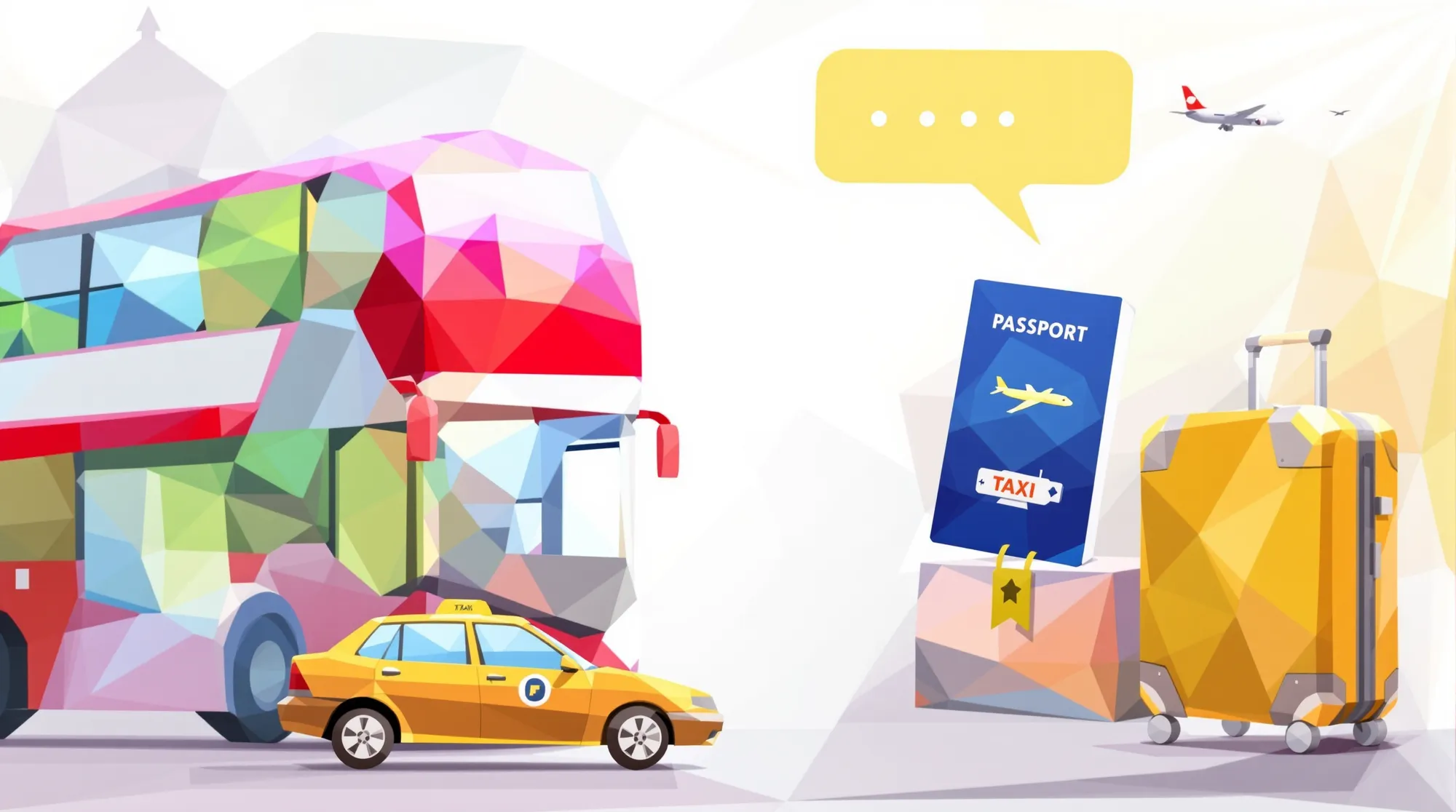
Flying into London, landing in New York, or transiting through Dubai? English is the language you will actually use — not just in the UK, the US, Ireland, Canada or Australia, but at almost every airport, hotel desk and ticket counter on the planet. It is the default fallback when two people have no other language in common.
The good news: you do not need fluency. You need the right phrases at the right moment, said clearly. Airline staff, hotel receptionists and taxi drivers hear non-native English all day long — they are not judging your grammar. They are listening for the key words.
In this guide you will find 50+ essential English phrases organised by real travel situations: greetings, restaurants, directions, shopping, hotels, emergencies and transport. Every phrase includes audio pronunciation, so you can hear exactly how it sounds before you say it out loud.
👋 English Greetings and Basic Courtesy
English speakers use "please" and "thank you" far more often than most other languages do. Leaving them out does not sound direct — it sounds rude. Add them to everything.
Important
Pro tip: "Excuse me" opens a conversation, "I'm sorry" apologises for something. Mixing them up is the single most common mistake travellers make. Start every question to a stranger with "Excuse me".
🍽️ Restaurant and Food Phrases
Ordering food is where most travellers feel exposed. These phrases cover the whole meal, from the door to the bill.
Example
Ordering like a local: in Britain you ask for "the bill", in the United States you ask for "the check". Both are understood everywhere, but using the local one makes the exchange feel effortless.
Notes
"Can I get a coffee" is extremely common in the US and sounds normal there. In the UK it can sound abrupt — "Could I have a coffee, please" is the safer version anywhere.
Become bilingual in 30 days with Univext!
Start a lesson with our teacher for free and become bilingual like our 100,000 students!
🗺️ Asking for Directions
Phone batteries die and city centres block GPS. These are the phrases that get you back on track.
Example
Useful combo: "Excuse me, how do I get to the station?" This one formula works for any destination — the airport, the hospital, the museum, the nearest pharmacy.




Join more than 100,000 students learning on Univext
🛍️ Shopping Phrases
From a market stall to a department store, these seven phrases handle almost every purchase.
🏨 Hotel and Accommodation
Check-in, check-out, and the small requests in between.
Become bilingual in 30 days with Univext!
Start a lesson with our teacher for free and become bilingual like our 100,000 students!
🚨 Emergency Phrases
You will probably never need these. Learn them anyway — under stress you will not have time to look them up.
Important
Emergency numbers differ by country: 999 in the UK and Ireland, 911 in the US and Canada, 000 in Australia, 111 in New Zealand. The EU-wide 112 also works in the UK and Ireland.
🚆 Transportation Phrases
Trains, buses, taxis and airports — the four places where a missing phrase costs you real money.
Join more than 100,000 students learning on Univext
💬 Numbers and Useful Extras
Numbers appear constantly: prices, platforms, room numbers, times.
Notes
"Could you speak more slowly, please?" is the most valuable sentence in this entire guide. Native speakers automatically slow down once you ask — but almost nobody asks.
Become bilingual in 30 days with Univext!
Start a lesson with our teacher for free and become bilingual like our 100,000 students!
🚀 How to Actually Learn These Phrases
A phrase list is a starting point. If you cannot pronounce a phrase or recall it while a taxi driver waits, it will not help you.
Here is what actually works:
1. Listen and repeat. English spelling is a poor guide to English pronunciation — "though", "through" and "tough" share four letters and sound nothing alike. Use the audio buttons above and copy the sound, not the spelling.
2. Practise in context. Do not memorise isolated words. Rehearse whole exchanges: arriving at a hotel, ordering a meal, buying a ticket.
3. Use an AI tutor for conversation practice. Apps like Univext let you practise English conversations with Umi, an AI teacher who speaks native English and corrects your mistakes as you make them — the part a phrasebook can never do.
Important
Univext offers a 14-day free trial with 30 minutes per day — enough to rehearse every phrase in this guide before you fly. Start your free trial →
4. Focus on the 80/20 rule. These phrases cover roughly 80% of ordinary tourist interactions. You do not need English grammar lessons before your trip. You need these sentences, spoken with confidence.
📊 Phrasebook vs App vs AI Tutor
Not sure which tool to take with you? Here is how the options compare:
Notes
A phrasebook gets you through a transaction. It cannot teach you to understand the answer — and in English the answer usually arrives fast, in an accent you have never heard. Conversation practice is the part that closes that gap.
🌍 Cultural Tips That Go With the Language
The phrases work better when you know the habits around them:
- Politeness is grammatical. "Give me a coffee" is understood but sounds like an order. "Could I have a coffee, please" is the normal register almost everywhere.
- Small talk is real. A shop assistant asking "How are you?" is greeting you, not enquiring about your health. "Fine, thanks — and you?" is the whole expected answer.
- Queueing matters in the UK. Cutting a line is a genuine social offence. Find the end of it and wait.
- Tipping varies enormously. 15-20% is expected in restaurants in the United States; in the UK 10% is generous and often already included; in Australia and New Zealand it is optional.
- Accents change everything. Glasgow, Dublin, Texas and Singapore all speak English and sound nothing like each other. Do not assume your listening broke — ask them to slow down.
Become bilingual in 30 days with Univext!
Start a lesson with our teacher for free and become bilingual like our 100,000 students!
🎯 Ready to Go Beyond Phrases?
These 50+ phrases will carry you through a trip. But if you want to actually hold a conversation — understand the reply, chat with your host, handle a problem at the airport desk — you need practice, not a longer list.
Univext gives you an AI English tutor named Umi who speaks native English, corrects your pronunciation, explains grammar only when you need it, and adapts every lesson to your level. No textbook, no memorisation drills — just conversation.
For a detailed comparison of English learning tools, see our guide to the best apps to learn English in 2026. Learning another language too? We also cover French, Spanish, German, Italian, Portuguese, Russian, Polish, and Ukrainian.
Important
Try Univext free for 14 days → Practise every phrase in this guide with Umi before you travel. 30 minutes a day is all you need.