


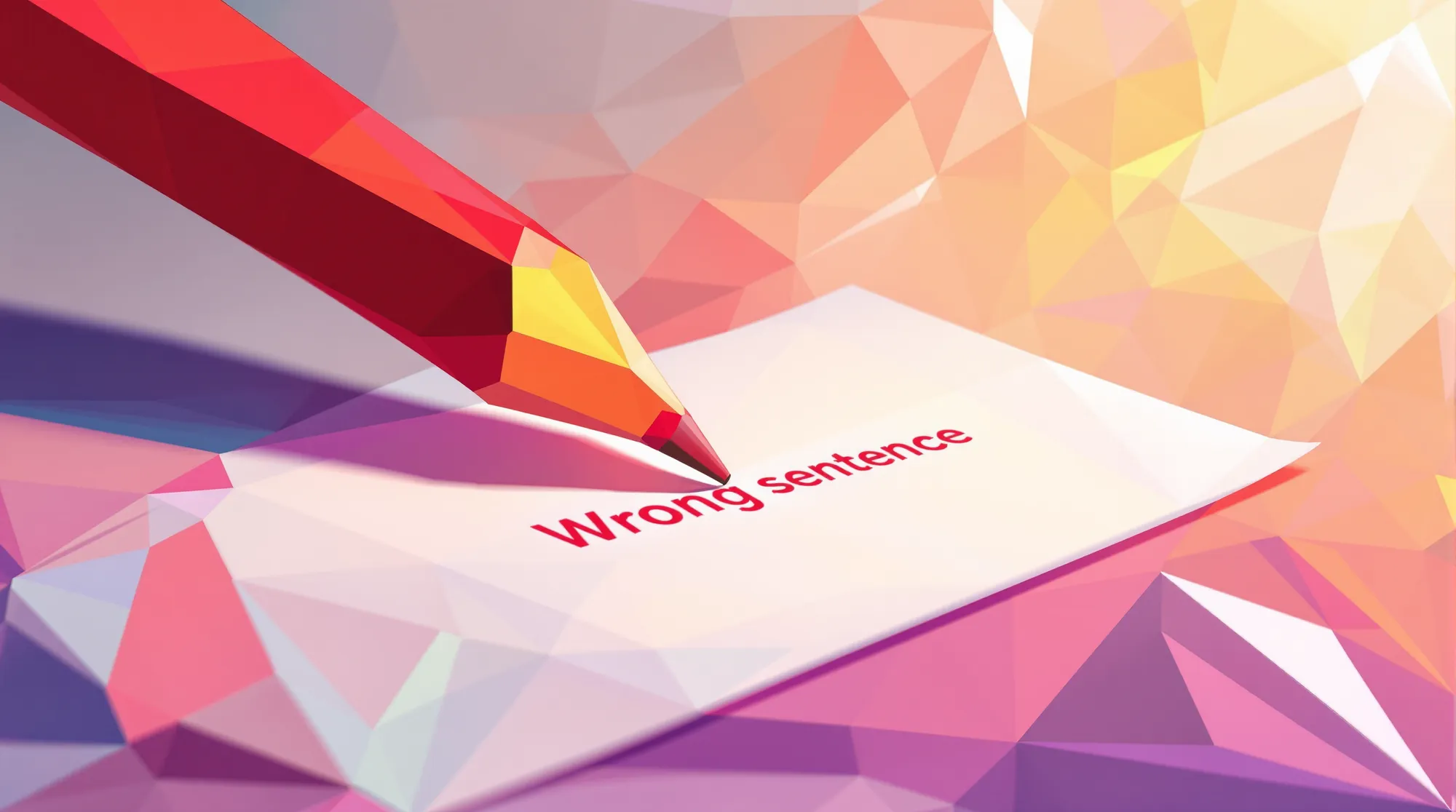
Every English learner makes the same mistakes. Not because they are careless — because their first language quietly lies to them. It tells them a sentence can start with "I am teacher." It tells them actually means "currently." It tells them you can say I have seen him yesterday because the meaning is obvious.
English disagrees. And the gap between what your native language expects and what English actually does is where almost every learner error lives.
Below are the 15 mistakes that show up in nearly every learner's first years — the tense that natives hear immediately, the missing articles, the false friends that make you say something you did not mean, and the prepositions no rule will ever fully explain. Each one gets the wrong version, the right version, and a one-line reason so it actually sticks.
Fix these fifteen and you stop sounding like someone translating, and start sounding like someone speaking.
⏳ 1. Present Perfect With a Finished Time
The single most common English mistake, and the one natives notice fastest.
- ❌ I have seen him yesterday.
- ✅
- ✅
Why: the present perfect cannot live next to a finished time expression — yesterday, last year, in 2019, two days ago. If the time is over, the verb must be past simple. The present perfect is for time that is still open.
📌 2. Dropping the Article Before a Job or a Singular Noun
- ❌ I am teacher. / She is engineer.
- ✅
- ✅
Why: English almost never leaves a singular countable noun naked. It needs a, an, the, my, this — something. Many languages have no articles at all, which is exactly why this one survives for years.
Notes
The mirror mistake is adding the where English wants nothing: I like the music means one specific piece of music. If you mean music in general, it is simply I like music.
Become bilingual in 30 days with Univext!
Start a lesson with our teacher for free and become bilingual like our 100,000 students!
📆 3. Since vs For
- ❌ I live here since three years.
- ✅
- ✅
Why: for takes a length of time. Since takes a starting point. And notice the tense: an action that started in the past and is still true takes the present perfect in English, not the present.





Join more than 100,000 students learning on Univext
🧍 4. Forgetting the -s on He, She, It
- ❌ He go to work at eight. / She don't like coffee.
- ✅
- ✅
Why: English conjugation is almost dead — one single survivor, the third-person -s. Because it is the only one, forgetting it is very audible. It is a habit problem, not a knowledge problem.
🔗 5. Guessing the Preposition After a Verb
There is no logic here. There are only collocations, and they have to be learned as blocks.
Why: the preposition belongs to the verb, not to the meaning. Learn depend on as one word, the way you learned goodbye as one word.
Become bilingual in 30 days with Univext!
Start a lesson with our teacher for free and become bilingual like our 100,000 students!
🗣️ 6. Explain Me Instead of Explain to Me
- ❌ Can you explain me this rule?
- ✅
Why: English lets you say give me the book or tell me the truth, but explain, describe, suggest and recommend refuse a bare person. They need to. This is arbitrary, and natives cannot tell you why either.
🚫 7. Making Uncountable Nouns Plural
- ❌ I need some informations. / He gave me two advices.
- ✅
- ✅
Why: information, advice, news, furniture, money, luggage, research, homework have no plural in English, even when they clearly do in your language. To count them, you count the container: a piece of advice, an item of news.
Join more than 100,000 students learning on Univext
👥 8. People Is and Everybody Are
- ❌ People is very friendly here. / Everybody are ready.
- ✅
- ✅
Why: people is already plural — the singular is person. And everybody, somebody, nobody, each look plural in meaning but are grammatically singular. English is counting the word, not the crowd.
Become bilingual in 30 days with Univext!
Start a lesson with our teacher for free and become bilingual like our 100,000 students!
🎭 9. False Friends: Actually, Eventually, Sensible
Small words, embarrassing consequences — and the sentence still works, so nobody corrects you.
Why: these words exist in dozens of languages with a different meaning, usually because both borrowed them from Latin and then drifted apart.
🧱 10. Make vs Do
- ❌ I must make my homework. / She did a mistake.
- ✅
- ✅
Why: roughly, make is for producing something that did not exist — a cake, a decision, a mistake, a noise. Do is for activity and duty — homework, the dishes, business, your best. Most languages use one verb for both, which is why this one never feels natural.
😴 11. I Am Boring vs I Am Bored
The mistake that accidentally insults you.
- ❌ I am boring in this class. → you are saying you are the dull one.
- ✅
- ✅
Why: -ing describes the cause, -ed describes the person feeling it. Same for interested and interesting, confused and confusing, tired and tiring.
Become bilingual in 30 days with Univext!
Start a lesson with our teacher for free and become bilingual like our 100,000 students!
😂 12. Fun vs Funny
- ❌ The party was very funny. → you mean it made you laugh at it.
- ✅
- ✅
Why: fun is enjoyable. Funny makes you laugh — and it also means strange, which is why you are funny can go two ways.
❓ 13. Question Word Order Inside a Sentence
- ❌ Do you know where is the station?
- ✅
- ✅
Why: English inverts the verb only in a direct question. Once the question is buried inside another sentence, the word order goes back to normal: subject, then verb.
🎯 14. I Am Agree and Other Adjective Confusions
- ❌ I am agree with you.
- ✅
- ❌ I have 25 years.
- ✅
Why: agree is already a verb in English, so it needs no am. And English is an age instead of having one — the exact opposite of French, Spanish, Italian and Portuguese.
Become bilingual in 30 days with Univext!
Start a lesson with our teacher for free and become bilingual like our 100,000 students!
🔊 15. Learning English Without Ever Speaking It
The mistake that makes all the others permanent.
Articles, the third-person -s, depends on, bored and boring — none of these are knowledge problems. You can recite the present perfect rule perfectly and still say I have seen him yesterday the second someone asks about your weekend. They are reflex problems, and reflexes only build in real time, under mild pressure, with someone correcting you the instant you slip.
Reading this article will not fix your English. Saying these fifteen sentences out loud, badly, to something that answers back — that will.
Join more than 100,000 students learning on Univext
🚀 How to Actually Fix These
Umi is Univext's AI tutor. You speak English out loud, and Umi corrects you the moment you drop an article or say I am boring — at the exact second a native speaker would notice and politely say nothing.
Important
Start a free English lesson with Umi — 14-day free trial, 30 minutes a day. Say I saw him yesterday out loud once, correctly, and it is yours forever. Try a free English lesson →
🎓 Keep Going
- Best Apps to Learn English in 2026 (Tested & Ranked)
- Why Is English So Hard? The Real Reasons (And How to Make It Easier)
- How Long Does It Take to Learn English? (Realistic Timeline)
- How to Use ChatGPT to Learn English (2026 Guide)
The learners who stop making these mistakes are not the ones who studied them hardest. They are the ones who made them out loud, early, and got corrected fast.