
🇰🇷 Babbel vs Rosetta Stone for Korean: The Quick Verdict
Let's settle this in the first paragraph, because for Korean there's a fact that ends the comparison before it starts.
Babbel does not offer Korean. It never has. Babbel sells around 14 languages — Spanish, French, German, Italian, Portuguese, Polish, Russian, Dutch, Turkish, Danish, Norwegian, Swedish, Indonesian and English — and its catalogue is built almost entirely around European languages. Korean is not on the list, at any price, on any plan.
Rosetta Stone does offer Korean. It's part of their all-languages subscription, structured as 12 units covering travel, shopping, health and everyday situations, with four lessons per unit.
So the honest verdict is: Rosetta Stone wins by default, because it's the only one of the two that has a Korean course at all.
But "wins by default" is not the same as "will get you speaking Korean," and that's the part worth your next five minutes. Korean is an SOV language with particles, a layered honorific system, and a verb that changes shape depending on who you're talking to. A course built on clicking the right photograph has a specific, predictable blind spot when it meets that.
Important
Babbel has no Korean course. Rosetta Stone does. The real question isn't which of the two to pick — it's whether Rosetta Stone's picture-matching method can teach a language where the politeness level of every single sentence is a decision you have to make.
🧩 Why Babbel Has No Korean Course
This isn't an oversight you should expect them to fix next quarter. It's structural, and it tells you something useful about the product.
Babbel's whole method is built by human linguists writing dialogue-based lessons for a specific language pair — German speakers learning Spanish, English speakers learning French. Each course is hand-authored for the direction it teaches. That's genuinely a strength for the languages it covers; it's also brutally expensive to scale, which is why the catalogue has hovered around 14 languages for years and leans European.
Korean, from an English speaker's starting point, would need the whole thing rebuilt: a non-Latin writing system, a word order that inverts the English sentence, a particle system with no English analogue, and speech levels that have no European equivalent at all. That's not a new course — it's a new product.
Notes
If you find a page claiming "Babbel Korean," check it carefully. It's usually an affiliate roundup with a misleading headline, or a Babbel podcast-style content page rather than an actual course. There is no Korean course to subscribe to.
Become bilingual in 30 days with Univext!
Start a lesson with our teacher for free and become bilingual like our 100,000 students!
🗿 What Rosetta Stone Actually Offers for Korean
Rosetta Stone's Korean course exists, it's real, and it has one genuine strength worth naming before we get to the limits.
The Method
- Immersion, no translation. You see images, hear Korean, and match them. English is deliberately kept out.
- Speech recognition. Their TruAccent engine scores your pronunciation against native recordings.
- Spaced repetition. Vocabulary comes back on a review schedule.
- 12 units. Travel, shopping, health, daily life — four lessons each.
What It Genuinely Does Well
- Pronunciation drilling. The speech-recognition feedback is the strongest part of the product, and Korean benefits: the difference between (fire) and (grass) is aspiration, and it's the kind of thing you need corrected out loud, not explained in a note.
- Listening comprehension. Sustained exposure to native audio with no English crutch does build your ear.
- No hand-holding into bad habits. Because there's no translation, you don't build the habit of mentally composing English first.
- One subscription, 25 languages. If you're also curious about Japanese or Mandarin, that's real value.
Where It Falls Short — Specifically for Korean
- Hangul gets undersold. Here's the irony: Hangul is genuinely, famously easy — a featural alphabet you can learn in a weekend, arguably the single most learner-friendly writing system in the world. Rosetta Stone's photo-first method doesn't take advantage of that. You could own the alphabet in two days and then spend months clicking pictures.
- Speech levels are invisible in photographs. This is the big one. Korean forces you to choose a politeness level in every sentence you utter. , and the plain form all mean "I eat," and picking the wrong one with the wrong person ranges from odd to genuinely rude. A picture of someone eating cannot encode who they're talking to.
- Particles go unexplained. Korean marks the role of every noun with a particle — , , , , , . The difference between the topic marker and the subject marker is one of the hardest things in the language and one of the most consequential. Immersion shows you the particles changing; it never tells you why.
- SOV word order by osmosis only. Korean puts the verb at the end and stacks everything before it. You'll absorb the pattern eventually, but "eventually" is doing heavy lifting.
- No real conversation. Reading a sentence at a microphone is pronunciation practice, not a conversation.
- Course depth. Twelve units is a solid beginner foundation. Korean is an FSI Category IV language — roughly 2,200 class hours for English speakers. Twelve units is the first small step of a long climb.
Notes
Rosetta Stone for Korean is best understood as a pronunciation and listening tool with a beginner vocabulary base. Used that way it has real value. Used as your whole plan, you'll finish 12 units and still not be able to decide how politely to address the person in front of you.





Join more than 100,000 students learning on Univext
📊 Side-by-Side: Babbel vs Rosetta Stone for Korean
The honest read of this table: only one column has a product in it, and that product has a hole exactly where Korean is hardest.
🗣️ The Real Problem: Recognition Isn't Speaking
Here's what neither company's marketing says. You can finish every unit Rosetta Stone offers and still freeze when a barista in Seoul asks what you'd like.
Why? Because picture-matching is a recognition exercise. The correct answer is already on the screen; your job is to identify it. Your brain never does the hard part — reaching into empty space and pulling a Korean sentence out, with the right particle on every noun and the right ending on the verb.
Korean widens that gap more than almost any language, and for one specific reason: the politeness decision comes first and it changes the verb. Before you can say anything, you've had to place the person in front of you — older, younger, a stranger, your boss, a friend — and that placement rewrites the end of your sentence. A photograph never asked you to do that. There was no one in front of you.
Then there's the particle. You want to say "I like coffee." Is coffee the topic or the object? or ? Both are grammatical; they mean different things. Clicking a picture of coffee teaches you the word and skips the entire decision.
And the verb comes last, so you have to hold the whole sentence in your head before you can finish it. That's a production skill. Recognition exercises don't build it, no matter how many of them you do.
Real conversation is the opposite. You reach for a word, put the wrong particle on it, get corrected, try again. That struggle is the learning — and it's exactly what a picture-matching interface can't simulate. If you want the best app to learn languages in a way that ends with you actually talking, you have to look past the tiles and the photographs alike.
Become bilingual in 30 days with Univext!
Start a lesson with our teacher for free and become bilingual like our 100,000 students!
🚀 What to Do Instead: AI Conversation Practice
Since Babbel isn't an option and Rosetta Stone stops short of speaking, the useful question becomes: what fills the gap?
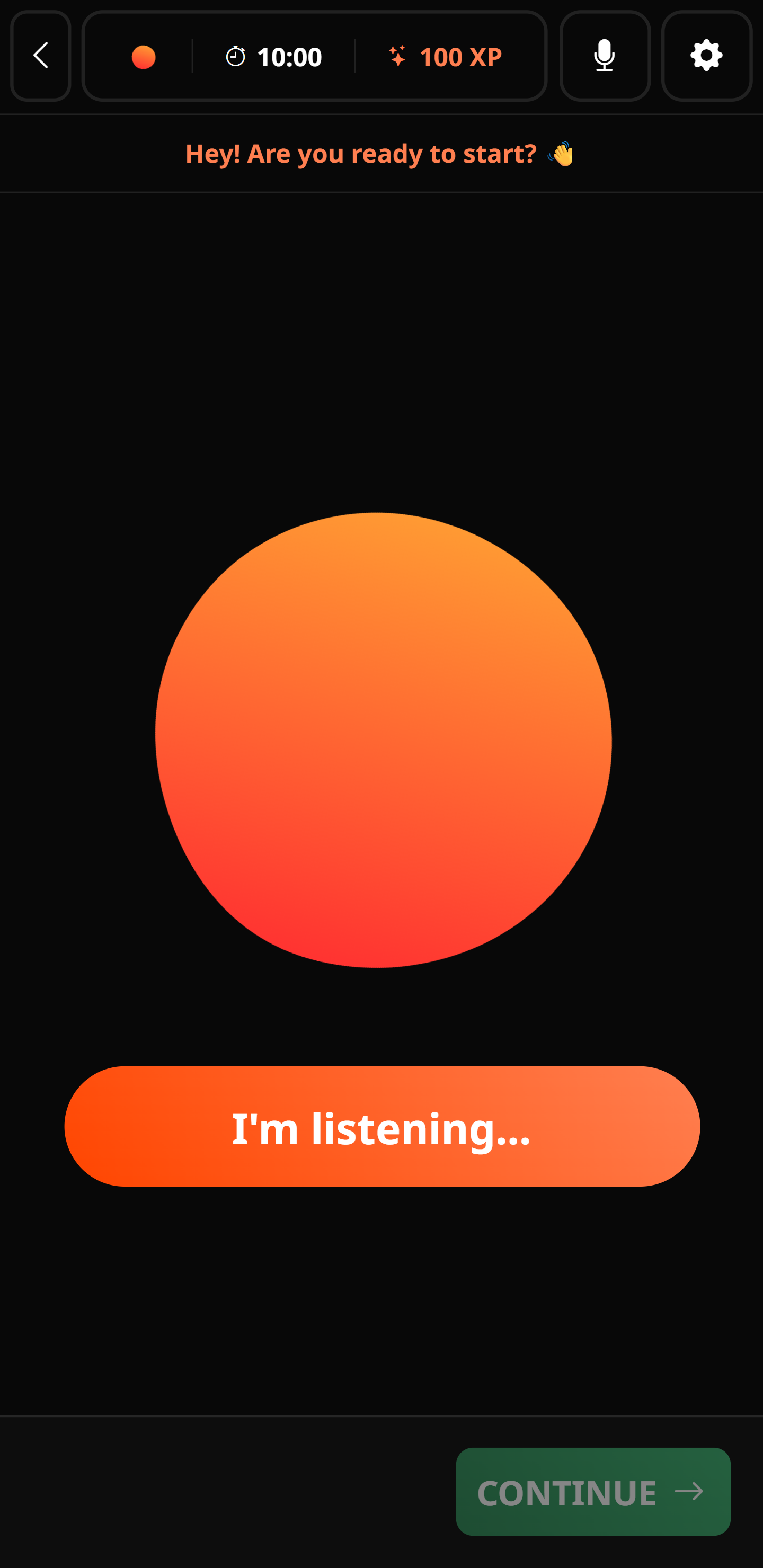
This is where Univext changes the equation. Instead of photographs, you get Umi — an AI tutor that talks with you, in Korean, about whatever you want, whenever you want.
Umi doesn't quiz you. It has a conversation with you. Tell it about your weekend, practise ordering at a café in Hongdae, role-play meeting a colleague's parents. There are no picture banks. You produce the sentence yourself — particles, verb ending, politeness level and all. That's the entire point.
Why this works where the apps stall
- Real-time correction. Use where you needed and Umi corrects you in the moment you needed it, not in a grammar note you skipped.
- It handles the politeness level explicitly. Practise the same sentence to a friend and to your boss and hear how the ending changes. No photograph can teach this; a conversation partner can teach nothing else.
- It remembers. Keep dropping the object particle? Umi quietly weaves more of those sentences into tomorrow's conversation until it stops being a decision and starts being automatic.
- Zero judgment. Mangle fifty times. Umi never sighs, never checks the clock, never costs $40 an hour.
- Output from day one. You build sentences from nothing — the only exercise that transfers to a real conversation.
Important
Ready to actually speak Korean? Univext gives you a 14-day free trial with 30 minutes of conversation a day. Put down the pictures and say something. Register here.
🎯 Which Should You Choose?
Babbel isn't a choice here. There is no Korean course. Don't buy a subscription hoping to find one, and don't let an affiliate roundup convince you otherwise.
Choose Rosetta Stone if:
- You want structured pronunciation drilling with speech feedback, and you learn well from immersion without translation.
- You're also interested in other languages in their catalogue and want one subscription to cover them.
- You accept it as a beginner foundation, not the whole plan.
Choose Univext if:
- You already know some Korean words but freeze when it's your turn to talk.
- You want the particles and the speech levels explained while you're using them wrong, which is the only time the explanation sticks.
- You want to reach a real conversation as fast as possible.
- You want a tutor's correction without a tutor's price or calendar.
The combination most learners land on: spend a weekend on Hangul (it really is that fast), use Rosetta Stone or a vocabulary app for reps, and use Univext for the speaking that neither can structurally provide.
Join more than 100,000 students learning on Univext
❓ FAQ
Does Babbel have a Korean course? No. Babbel offers around 14 languages, almost all European — Spanish, French, German, Italian, Portuguese, Polish, Russian, Dutch, Turkish, Danish, Norwegian, Swedish, Indonesian and English. Korean is not among them, on any plan.
Does Rosetta Stone have Korean? Yes. It's included in their all-languages subscription, built as 12 units of four lessons each, covering everyday topics like travel, shopping and health.
Is Rosetta Stone good for Korean? It's good for two things: pronunciation, thanks to its speech-recognition feedback, and listening comprehension. It's weak on particles, silent on speech levels and honorifics, and light on explicit grammar by design. Treat it as a starting point, not a finish line.
How hard is Korean for English speakers? Hangul is genuinely easy — most people read it after a weekend, and it's one of the most elegantly designed writing systems in existence. The rest is harder: the US Foreign Service Institute puts Korean in Category IV, around 2,200 hours for English speakers, largely because of the honorific system, particles and SOV word order. We cover the realistic picture in is Korean hard to learn.
Can you become fluent with Rosetta Stone alone? No. It builds recognition, pronunciation and vocabulary, not production. With Korean that limit is sharp, because recognising a sentence in a photo caption isn't the same skill as choosing a politeness level under pressure. Learners who get fluent add conversation practice on top.
What are the best Babbel alternatives for Korean? Since Babbel doesn't compete here at all, the field is Rosetta Stone or a Korean-specialised app for basics, plus an AI or human tutor for speaking. We break down the wider field in our guides to Babbel alternatives and Rosetta Stone alternatives, and our roundup of the best apps to learn Korean.
What's the fastest way to actually speak Korean? Daily output with immediate correction. That means talking — to a human tutor, or to an AI one. Univext's free trial gives you 30 minutes a day of exactly that.
Become bilingual in 30 days with Univext!
Start a lesson with our teacher for free and become bilingual like our 100,000 students!
💡 Bottom Line
"Babbel vs Rosetta Stone for Korean" turns out to have a one-line answer: Babbel doesn't make a Korean course, so Rosetta Stone wins the matchup unopposed. Anyone selling you a head-to-head of the two is comparing something to nothing.
The more useful question is what Rosetta Stone leaves out. It gives you pronunciation feedback, listening exposure and a beginner vocabulary base — real value, genuinely worth using. It does not give you particles, speech levels, or the ability to produce a Korean sentence out of your own head while simultaneously deciding how politely to say it. That's not a knock on the app; it's just what a picture-matching interface is.
Korean is a system of relationships, not a word list. Every sentence encodes who you are to the person you're speaking to. The only way to learn that is to use it wrong in front of someone, get corrected, and use it again — out loud, until it's automatic.
That's the gap Univext was built for. Learn Hangul this weekend. But if you want to speak, you have to start speaking.
Important
Don't just learn Korean — speak it. Start your 14-day free trial with Univext and get 30 minutes of daily conversation with Umi. Claim your trial here.