


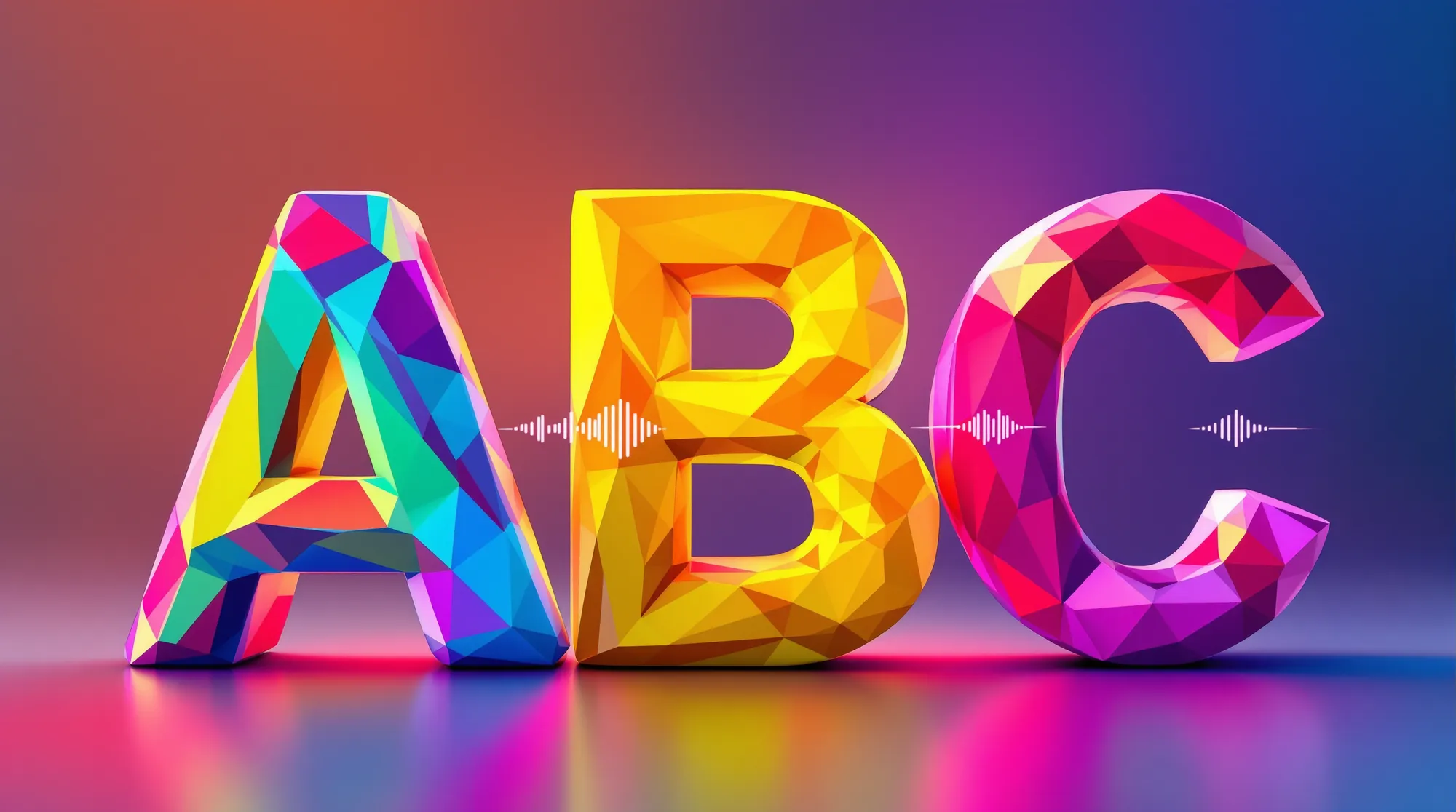
🔤 The English Alphabet: 26 Letters, 44 Sounds
The English alphabet has 26 letters — 5 vowels (A, E, I, O, U) and 21 consonants. That part takes an afternoon. The part that takes longer, and that nobody warns you about, is this: those 26 letters have to cover roughly 44 distinct sounds. That mismatch is the entire reason English spelling has a reputation.
The good news: you already know the shapes. English uses the plain Latin script — no accents, no extra characters, no ß, no ñ, no Cyrillic. If you can read a street sign in Spanish, French, German or Indonesian, you can already see every English letter. What you need is the sound attached to each one.
Important
Reading the letters is easy. Saying them so a native understands you is the real skill — and it needs a listener. Our AI teacher Umi hears you read aloud and corrects your pronunciation instantly. Start a 14-day free trial and read your first English words out loud tonight.
If you want the wider picture of English-learning tools, see our roundup of the Best Apps to Learn English in 2026.
📋 All 26 Letters and Their Names
Every English letter has a name (what you say when you spell out loud) and one or more sounds (what it does inside a word). They are not the same thing — this is the single biggest trap for beginners. Click each letter to hear a native speaker say its name.
Notes
Z is the one letter with two accepted names: British speakers say "zed", Americans say "zee". Both are correct. Everything else in the list is identical on both sides of the Atlantic.
Become bilingual in 30 days with Univext!
Start a lesson with our teacher for free and become bilingual like our 100,000 students!
🅰️ Vowels: 5 Letters, About 20 Sounds
The five vowel letters do the heaviest lifting in English. Each one has at least a short and a long version, and the long version usually sounds like the letter's own name.
Example
The classic rule: a silent E at the end of a word makes the vowel before it say its own name. becomes . becomes . becomes .
And then there is the sound that appears more often than any other in spoken English: the schwa, a lazy "uh" that any unstressed vowel collapses into — the a in , the o in , the e in . Master the schwa and you instantly sound less robotic.





Join more than 100,000 students learning on Univext
🔊 Consonants and the Combinations That Matter
Most English consonants behave. A few only make sense in pairs:
⚠️ The 5 Traps That Actually Catch Learners
These are the mistakes that make a fluent-on-paper speaker hard to understand. Everything above is knowledge; this is where practice is non-negotiable.
1. TH — the sound your language probably doesn't have. Speakers of Spanish, Portuguese, French, Russian, Japanese and Chinese all tend to replace it with s, z, t or d. becomes "tree", becomes "dat". Your tongue must physically touch your teeth.
2. R and L. For Japanese, Korean and Chinese speakers these are one sound, not two. and are entirely different words. The English R also never rolls — the tongue curls back and touches nothing.
3. W and V. German, Russian, Hindi and Dutch speakers routinely swap them. and are a real minimal pair.
4. Silent letters. English keeps letters it stopped pronouncing centuries ago: the K in , the B in , the W in , the GH in , the L in .
5. Same spelling, different sound. , , and share -ough and share nothing else. There is no rule here. There is only exposure.
Important
Notice what these five have in common: not one of them can be fixed by reading. They are all mouth problems, and a mouth problem needs someone listening. Try a free lesson with Umi — she hears exactly which of the five is holding you back, and drills it with you.
Become bilingual in 30 days with Univext!
Start a lesson with our teacher for free and become bilingual like our 100,000 students!
✍️ Spelling Out Loud
English speakers spell names, emails and postcodes out loud constantly — at the bank, at the airport, on the phone. It is one of the first real-world skills you need, and it uses letter names, not letter sounds.
Example
"How do you spell that?" — . Double letters are said as "double": for the middle of hello.
🚀 What To Do Next
Learn the 26 letter names today — genuinely, that is one afternoon. Then stop reading about English and start saying it. The alphabet is not knowledge you accumulate; it is a set of muscle movements you rehearse until they are automatic.
Important
You already know the letters. Now find out what your accent actually sounds like. Start your 14-day free trial — 30 minutes a day with Umi, who listens, corrects, and never gets bored of repeating a sound.