


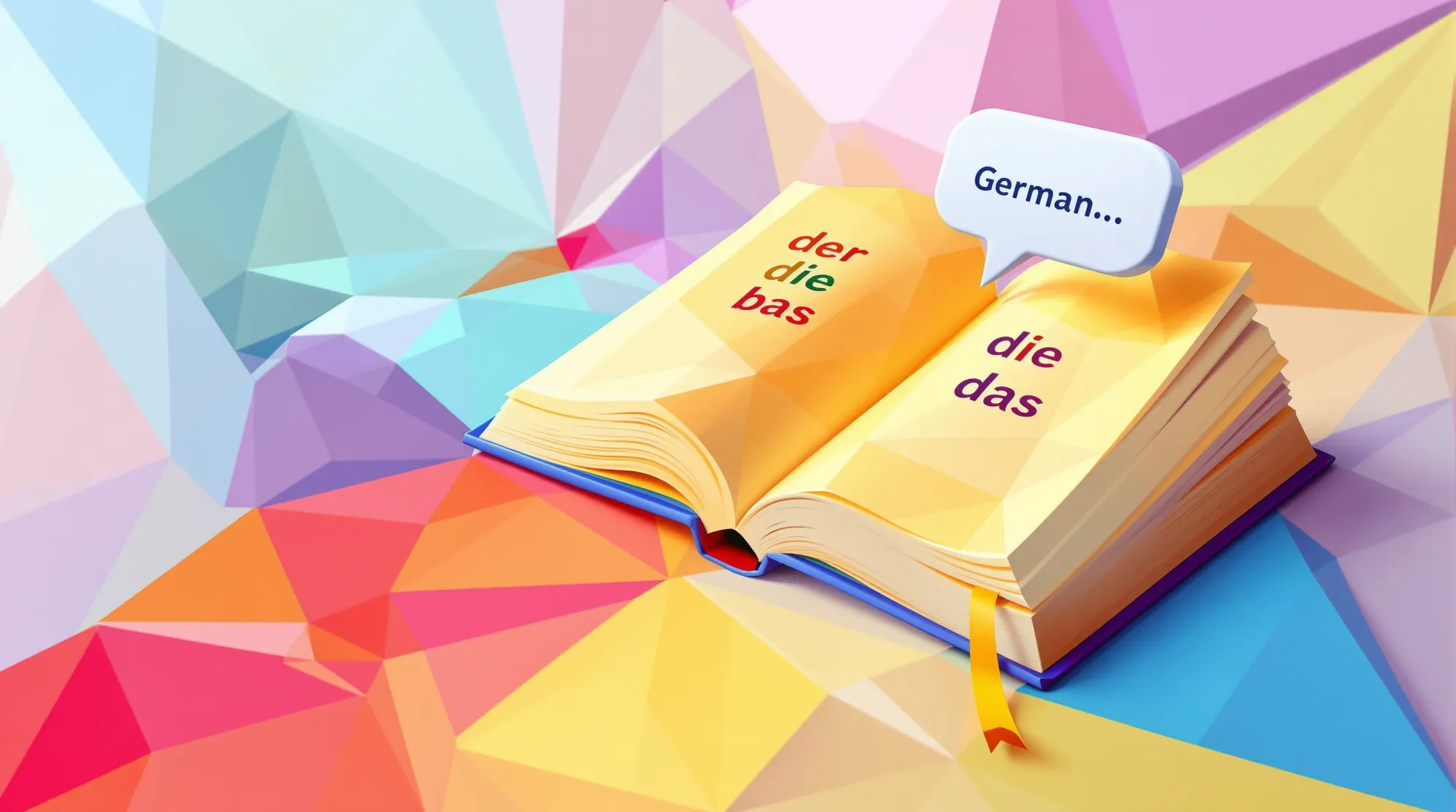
German grammar has a reputation for being intimidating — three genders, four cases, verbs that jump to the middle of the sentence. Here's the good news: German is one of the most systematic languages there is. Once the building blocks click, you stop guessing and start recognizing patterns — and the whole thing feels far more logical than English ever did.
This is your quick-start map. Not a textbook — a friendly tour of the pieces that make German work, so you can see for yourself: this is learnable. By the end you'll recognize how sentences are built, why little words change shape, and what to focus on first. Then the fastest way to lock it in is to actually speak it — more on that at the end.
🚻 Three Genders: der, die, das
Every German noun is masculine, feminine, or neuter — and the word for "the" changes to match:
It's not about biology — it's grammar. A table, , is masculine; the sun, , is feminine. There are patterns to help, but the smart move is simple.
Notes
Learn each noun together with its article — "der Tisch," not just "Tisch." That tiny habit saves you from guessing every case later.
🔄 Verbs Conjugate by Person
To speak German you take a verb, drop its ending, and add one that matches who is doing the action. Take — "to play":
Learn this one set of endings and you can conjugate hundreds of regular verbs. A handful of common verbs are irregular — like (to be) and (to have) — but you meet them so often they stick fast.
Become bilingual in 30 days with Univext!
Start a lesson with our teacher for free and become bilingual like our 100,000 students!
📦 The Four Cases (Don't Panic)
Here's the part everyone warns you about — and it's simpler than its reputation. German has four cases, which just means the little words around a noun (mostly "the" and "a") shift depending on the noun's job in the sentence:
- Nominative — the subject, who's doing it: — the dog sleeps.
- Accusative — the direct object, what's affected: — I see the dog. Notice der became den.
- Dative — the indirect object, to/for whom: — I give the dog water.
- Genitive — possession, whose: — the man's house.
Example
Same dog, three forms: der Hund (subject) → den Hund (object) → dem Hund (receiver). The noun barely changes; the article does the heavy lifting.
You do not need to master all four today. Just knowing they exist — and that the article carries the signal — puts you ahead of most beginners.





Join more than 100,000 students learning on Univext
🔀 The Verb Comes Second
German's golden rule of word order: in a normal statement, the conjugated verb sits in the second position — no matter what comes first.
- — I drink coffee today.
- — Today drink I coffee.
Start with "today" and the verb still comes second, bumping the subject after it. Once this clicks, German sentences stop feeling scrambled and start feeling predictable.
❓ Questions and Negatives
Good news — these are easy. To ask a yes/no question, just put the verb first:
- — you speak German → — do you speak German?
To make a sentence negative, German uses two little words. Use to negate a verb or adjective, and to say "no / not a" before a noun:
- — I don't understand.
- — I have no time.
Become bilingual in 30 days with Univext!
Start a lesson with our teacher for free and become bilingual like our 100,000 students!
🧩 How It All Fits Together
Here's the encouraging part: these pieces interlock. Once you know a noun's gender, the article follows through every case. Once you know the second-position rule, word order stops being a mystery. German rewards pattern-spotting more than almost any language — and beginners start spotting patterns quickly.
What you can't get from a guide like this is the muscle memory — the reflex of reaching for den over dem, of hearing "-st" and knowing it's "you." That only comes from using the language out loud, in real time, with instant correction.
🚀 The Fastest Way to Make It Stick
Reading about grammar is step one. Speaking it is where it becomes yours. That's exactly what Univext's AI tutor Umi is built for: real conversations in German, gently corrected as you go, at your level — no schedule, no judgment, available the moment the urge to learn strikes.
Important
Try a free German lesson with Umi right now. Speak your first sentences today — while the motivation is fresh. 👉 Start your free German lesson
Curious which app to learn on? See our tested breakdown of the Best Apps to Learn German in 2026, and why an AI tutor beats gamified apps for actually speaking.
You already took the hardest step — deciding to start. The grammar is learnable. Go say your first German sentence. Los geht's! 💪