
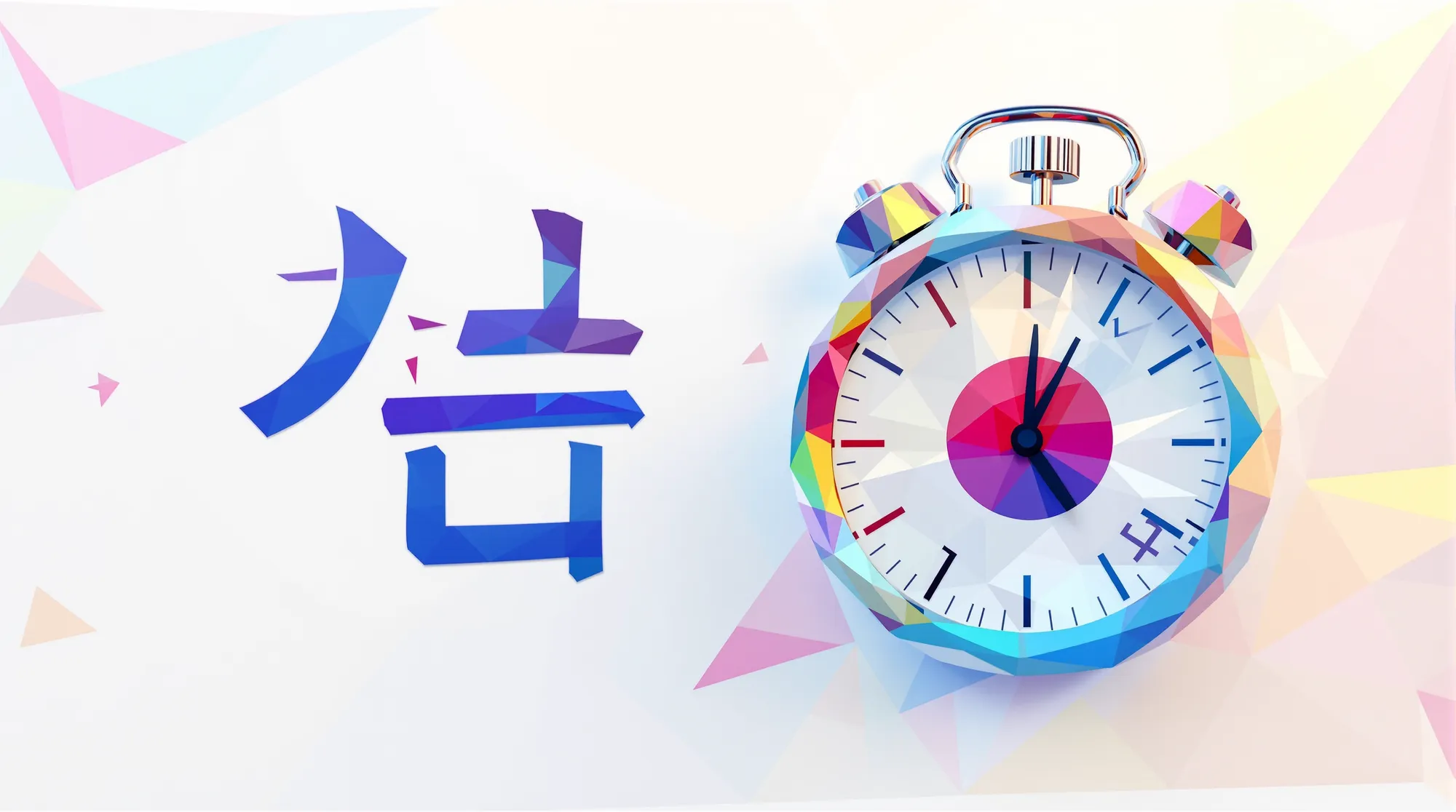
Every Korean learner asks the same question before they even start: how long is this actually going to take? It's a fair question — Korean has a reputation as one of the hardest languages for English speakers, and you deserve an honest answer, not a marketing promise that you'll be "fluent in 3 months."
The real answer: it depends on the level you want to reach, how consistently you show up, and whether you practice speaking or just study. But "it depends" is a useless answer, so this guide gives you the actual numbers — level by level, in study hours and in calendar time — plus the one part of Korean that's shockingly fast and the parts that take real patience. Let's make it concrete.
⏱️ The Short Answer
The U.S. Foreign Service Institute ranks Korean as a Category IV "super-hard" language for English speakers — the same tier as Japanese, Mandarin, and Arabic. That means it takes more hours than Spanish or French, and there's no honest way around it.
If you study consistently, here's roughly what you're looking at:
- Basic conversation (TOPIK 1–2): ~500–600 hours → survival Korean, everyday phrases
- Independent, confident use (TOPIK 3–4 / roughly B1–B2) — the level most learners actually want: ~1,200–1,700 hours
- Full professional fluency (TOPIK 5–6 / roughly C1): ~2,200 hours
- Near-native mastery: 2,800+ hours
That sounds like a lot — and it is. But here's the part nobody tells you up front: you can read Korean out loud in a single afternoon. The alphabet is the easiest win in all of language learning. The hours above are for fluency, not for getting started — and getting started is faster in Korean than in almost any other language.
🔤 Hangul: The Fastest Win in Language Learning
Before the hard numbers scare you off, learn this: Korean's writing system, Hangul (한글), was scientifically designed to be learned in a day. King Sejong created it in 1443 specifically so ordinary people could become literate quickly — and it works.
Hangul is a true alphabet with just 14 basic consonants and 10 basic vowels, combined into neat syllable blocks. The letter shapes even mirror the shape your mouth makes when you say them. Most learners can sound out Korean words — slowly — after 2 to 3 hours, and read comfortably within a week.
Example
Compare this to Japanese (two syllabaries plus thousands of kanji) or Chinese (thousands of characters). In Korean, you skip that entire mountain. By the end of your first weekend you'll be reading café signs and K-pop lyrics phonetically — even if you don't understand them yet.
That early win matters more than it sounds. It means from week one you're reading real Korean, not romanized crutches — and real input is what actually builds a language.
Become bilingual in 30 days with Univext!
Start a lesson with our teacher for free and become bilingual like our 100,000 students!
📊 Korean Levels and Hours: TOPIK and CEFR
Korean fluency is officially measured by TOPIK (Test of Proficiency in Korean), levels 1 through 6. Here's how TOPIK maps to the CEFR scale you may already know, and roughly how many study hours each level takes an English speaker starting from zero:
Notes
These are cumulative totals, not per-level. Reaching TOPIK 4 means roughly 1,400–1,700 hours from zero — not 1,400 on top of TOPIK 3.
A crucial detail: hours are not linear in difficulty. The jump from TOPIK 1 to 2 feels fast because everything is new and Hangul makes reading effortless. The climb from TOPIK 3 upward feels slower — this is where grammar and honorifics demand real work. This is completely normal. Don't mistake the plateau for failure.
Most people who say they want to "learn Korean" — to enjoy dramas without subtitles, travel confidently, or have real conversations — are really aiming for TOPIK 3–4. That's the sweet spot this guide is built around.


Join more than 100,000 students learning on Univext
🧠 What Makes Korean Take Longer (And What Doesn't)
Two learners can put in the same hours and end up at very different levels. Here's what actually moves the needle in Korean specifically.
The grammar is genuinely different
Korean is SOV (Subject-Object-Verb): you say "I lunch ate," not "I ate lunch." Meaning is carried by particles — small tags attached to words that mark the subject, object, or topic. And verbs conjugate for tense, politeness, and mood. None of this is harder than English grammar, but it's unfamiliar, so it takes repetition to feel natural rather than translated.
Honorifics and speech levels
This is the part that has no English equivalent. Korean encodes social relationships directly into the grammar. You speak differently to a friend (반말, casual) than to a stranger, elder, or boss (존댓말, polite). Choosing the wrong level isn't just a grammar slip — it can sound rude. Learning when to use each level is a skill you build through real conversation, not flashcards.
Important
The learners who stall on Korean are almost never the ones who lack talent — they're the ones who memorize vocabulary but never practice speaking, so honorifics and sentence-building never become automatic. Reading about Korean is not the same as producing it.
Consistency beats intensity
Thirty focused minutes every day will take you further than a five-hour cram session every Sunday. Language lives in long-term memory, which is built through spaced repetition — frequent, short exposures. A daily habit also keeps you from the brutal "start over every January" cycle that traps so many learners.
Immersion is easier than ever
Korean has a huge advantage most languages don't: K-dramas, K-pop, variety shows, and webtoons give you endless, addictive immersion. Every hour of real Korean input compounds on top of your study time — and unlike grammar drills, it's fun enough to actually keep doing.
🗣️ Why Speaking Is the Real Bottleneck
Here's the uncomfortable truth most apps won't tell you: you can complete a thousand vocabulary exercises and still be unable to order a coffee in Korean.
Understanding Korean (input) and producing Korean (output) are two different muscles. Traditional courses and gamified apps drill the first and neglect the second, which is why so many learners can read Hangul fluently and recognize hundreds of words but freeze the moment someone actually talks to them. Add honorifics — where you have to pick the right politeness level in real time — and the fear of getting it wrong keeps people silent for years.
This is exactly the gap that leaves people stuck at "high beginner forever." If you want to see why the most popular app in the world struggles here, read Why Duolingo Doesn't Teach You to Speak. The fix is simple to state and hard to do alone: practice speaking, early and often, in a low-pressure environment where mistakes cost nothing.
Become bilingual in 30 days with Univext!
Start a lesson with our teacher for free and become bilingual like our 100,000 students!
📅 Realistic Timelines by Study Pace
Same TOPIK 3–4 goal (~1,400 hours), different daily habits. Here's how the calendar math works out:
Example
A committed adult who studies 2 focused hours a day — say, an hour of structured practice plus an hour of K-dramas with active listening — can realistically reach solid TOPIK 3–4 conversational Korean in around two years. That's not a fantasy; that's a schedule. And basic survival Korean (TOPIK 1–2) comes far sooner, within the first several months.
The takeaway isn't "study more hours" (life gets in the way). It's make the hours you do have count — quality practice with real feedback beats passive scrolling every single time.
⚡ How to Learn Korean Faster
You can't skip the hours, but you can make each one worth more:
- Learn Hangul first, this week. Never rely on romanization — it wrecks your pronunciation and slows you down. Two afternoons and you're reading real Korean.
- Speak from week one. Don't wait until you "feel ready" — you never will. Produce Korean out loud daily, honorifics and all.
- Get corrected in real time. A mistake you don't know about becomes a habit — and with speech levels, an unnoticed mistake can sound rude. Immediate feedback is the fastest teacher.
- Prioritize the top 1,000 words. They cover the vast majority of everyday conversation. Fluency in the common stuff beats knowing rare vocabulary.
- Immerse for free. Watch K-dramas with Korean subtitles, follow Korean creators, switch your phone to Korean. You already love the culture — use it.
The learners who reach conversational Korean in a couple of years aren't smarter — they built a daily habit with real speaking practice and real feedback, instead of collecting streaks.
Join more than 100,000 students learning on Univext
🚀 The Fastest Path: A Tutor Who's Always Available
The single biggest accelerator is daily conversation practice with instant correction — and that's exactly what's historically been the expensive, hard-to-schedule part. A native Korean tutor costs money and lives in a very different time zone. Apps are cheap but don't actually let you talk — and they certainly don't coach you through honorifics.
That's the gap Univext closes. Our AI teacher, Umi, is a patient Korean tutor available 24/7 — you can have a real spoken conversation at 6 a.m. or midnight, make as many mistakes as you need, and get corrected instantly without ever feeling judged. Every lesson adapts to your level, so you're always practicing at the edge of your ability, where learning is fastest.
Important
Start free: Univext gives you a 14-day free trial with 30 minutes of practice per day. That's enough to build the speaking habit that gets you past the beginner plateau — before you pay a cent.
Not sure which app is right for you? We compared the field honestly in Best Apps to Learn Korean in 2026 and covered the AI-tutor angle in Learn Korean with AI: Best AI Tutors.
Become bilingual in 30 days with Univext!
Start a lesson with our teacher for free and become bilingual like our 100,000 students!
❓ Frequently Asked Questions
Can I learn Korean in 3 months? You can learn to read Hangul in a day and reach a functional survival level (TOPIK 1) in about 3 months with intensive daily study — enough for basic phrases, ordering food, and simple exchanges. True conversational fluency (TOPIK 3–4) takes far longer, realistically a couple of years with consistent effort.
How many hours a day should I study Korean? One to two focused hours a day is the sweet spot for committed learners — enough to make steady progress without burning out. If you only have 30 minutes, that's still enough, as long as it's every day and includes speaking, not just reading.
What's the hardest part of learning Korean? Not the alphabet — that's the easy part. The real challenges are the SOV grammar with particles, and the honorific speech levels that change how you talk depending on who you're speaking to. Both improve dramatically with regular conversation practice, which is why daily speaking beats more grammar drills.
Is Korean really one of the hardest languages? For English speakers, yes — the FSI puts it in the top difficulty tier. But "hard" mostly means "takes more hours," not "impossible." Hangul makes the start unusually easy, and the grammar is consistent and logical once it clicks. It's very learnable with a daily habit.
😎 The Bottom Line
Learning Korean to confident, conversational TOPIK 3–4 takes roughly 1,400–1,700 hours — about two years if you practice daily. It's a Category IV language, so there's no magic shortcut. But there is a fastest path: learn Hangul immediately, speak from day one, and get real feedback every day.
And remember the good news no other hard language offers — you'll be reading Korean by the end of your first weekend. The learners who make it aren't the ones with the most free time or the most talent. They're the ones who start today and show up every day. The sooner you begin, the sooner your countdown ends.
Ready to start your first conversation? Try a free lesson with Umi — sign up in under two minutes and speak your first Korean sentences today.